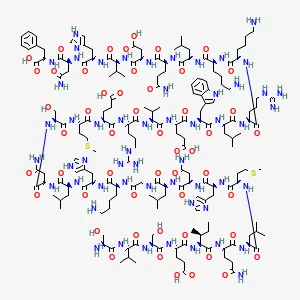
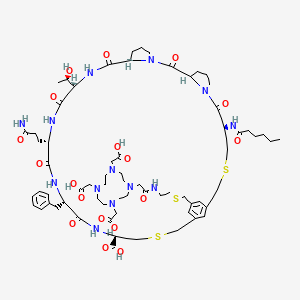
Hangzhou Leap Chem Co., Ltd. is one of the most professional manufacturers and suppliers of fap2286丨cas 2581741-18-4 in China. Welcome to wholesale bulk high quality chemical products at competitive price from our factory. If you have any enquiry about custom service, please feel free to email us.
Specifications
| Appearance | White solid |
| MS+1 | 1470 |
| Purity (HPLC) | 98% min |
Applications
FAP‑2286 is a cyclic peptide conjugated to a radionuclide chelator that binds selectively to the enzyme Fibroblast Activation Protein (FAP), which is overexpressed in certain tumor microenvironments. It is primarily used as a theranostic agent, meaning it can serve both diagnostic and therapeutic purposes. For diagnostic applications, FAP‑2286 can be labeled with positron-emitting radionuclides to produce PET tracers that visualize FAP-positive tumors and stromal regions, aiding in tumor detection, staging, and patient stratification. For therapeutic use, FAP‑2286 can be labeled with therapeutic radionuclides to deliver targeted radiotherapy to FAP-expressing cells, inhibiting tumor growth while minimizing exposure to healthy tissue. Additionally, FAP‑2286 is applied in research to study tumor stroma biology, fibroblast activation, and interactions within the tumor microenvironment, supporting the development of new FAP-targeted therapies and molecular probes.
Benefits
FAP‑2286 offers high affinity and selectivity toward FAP, ensuring strong and specific targeting of FAP-expressing cells while limiting off-target binding. Its chelator-conjugated structure allows labeling with various radionuclides for either diagnostic imaging or therapeutic purposes, providing flexibility for theranostic applications. The compound demonstrates favorable biodistribution, with rapid clearance from non-target tissues and strong retention in FAP-positive tumors, which improves imaging quality and therapeutic efficacy. Preclinical studies have shown that therapeutic versions can significantly inhibit tumor growth without causing major systemic toxicity. Its chemical stability, predictable pharmacokinetics, and well-characterized binding profile make it a reliable reagent for both laboratory research and development of targeted cancer therapies.
Conclusion
FAP‑2286 is a versatile cyclic peptide conjugate designed for selective targeting of FAP in tumors. Its combined diagnostic and therapeutic capabilities, along with high specificity, favorable biodistribution, and strong tumor retention, make it a valuable tool in cancer research, imaging, and targeted radionuclide therapy. The compound supports studies on tumor microenvironments, aids in the development of FAP-targeted therapeutics, and provides a flexible platform for theranostic applications, making it an important agent in both research and translational oncology.