

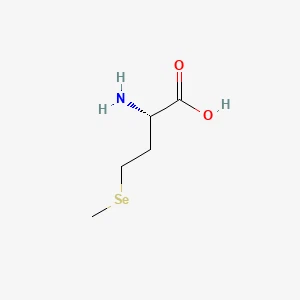
Hangzhou Leap Chem Co., Ltd. is one of the most professional manufacturers and suppliers of l-(+)-selenomethionine丨cas 3211-76-5 in China. Welcome to wholesale bulk high quality chemical products at competitive price from our factory. If you have any enquiry about custom service, please feel free to email us.
Specifications
| Appearance | White or off-white powder |
| Purity(HPLC) | 98% min |
| Content of selenium | 39% to 41% |
| IR | Infrared absorption spectrum consistent with the standard pattern |
| Optical rotation | +17° to +19.5° |
| Heavy metals | 0.002% max |
| Sodium content | 0.1% max |
| Water | 1% max |
Applications
L-(+)-Selenomethionine is widely used in nutritional supplements, pharmaceuticals, and biomedical research due to its role as an essential selenium-containing amino acid. In dietary supplements, it is incorporated as a highly bioavailable source of selenium, supporting antioxidant defenses, thyroid function, and overall immune health. It is often added to multivitamins, specialized selenium formulations, and fortified foods to address selenium deficiency in humans and animals. In pharmaceutical and clinical research, L-(+)-Selenomethionine is employed in studies related to oxidative stress, cancer prevention, cardiovascular health, and metabolic disorders, serving as a model compound for investigating selenium metabolism and selenoprotein synthesis. In biotechnology, it is used for isotopic labeling and incorporation into proteins for structural biology and enzymology studies, enabling the tracking of selenium-containing proteins in X-ray crystallography and mass spectrometry experiments. Additionally, it finds applications in animal nutrition, enhancing growth performance, reproductive health, and antioxidant capacity in livestock and poultry feeds.
Benefits
L-(+)-Selenomethionine offers several significant benefits due to its chemical stability, high bioavailability, and biological activity. Compared to inorganic selenium sources, it is more efficiently absorbed and incorporated into body proteins, allowing for sustained selenium supplementation and improved physiological effects. Its antioxidant properties help mitigate oxidative stress by supporting the activity of selenoenzymes such as glutathione peroxidases and thioredoxin reductases, contributing to cellular protection, immune function, and cardiovascular health. As a naturally occurring amino acid, it can be safely integrated into proteins and metabolic pathways without causing significant toxicity at appropriate doses. Its inclusion in research and protein-labeling studies provides precise, reliable results in structural analysis and enzyme characterization. In animal nutrition, it enhances growth, reproduction, and resistance to oxidative damage, improving overall health and productivity. The compound's versatility in both human and animal applications, combined with its critical role in selenoprotein biosynthesis, makes it a highly valuable component in health-promoting formulations and experimental studies.
Conclusion
L-(+)-Selenomethionine is a vital selenium-containing amino acid with broad applications in nutrition, pharmaceuticals, research, and animal health. Its high bioavailability, stability, and antioxidant properties make it an excellent supplement for supporting immune function, thyroid activity, and overall cellular protection. In scientific studies, it facilitates protein labeling, selenoprotein research, and metabolic investigations. Its benefits in both human and animal health, coupled with its utility in experimental and industrial contexts, underscore its importance as a functional and versatile compound in modern biomedical and nutritional applications.





