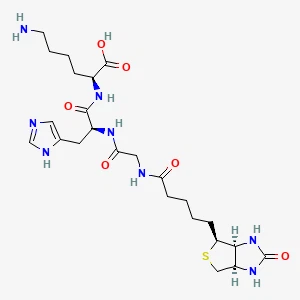
Hangzhou Leap Chem Co., Ltd. is one of the most professional manufacturers and suppliers of biotinoyl tripeptide-1丨cas 299157-54-3 in China. Welcome to wholesale custom made chemical products at competitive price from our factory. For more cheap products, contact us now.
Specifications
| Appearance | White to off-white powder |
| Identity by HPLC | The retention is same with the reference substance |
| Identity by MS | 566 ± 1 |
| Peptide purity (by HPLC) | 98% min |
| Solubility | 2 mg/ml in water max |
| Water content (Karl Fisher) | 8% max |
| Acetic acid content | 15% max |
| Peptide content | Reported value |
Applications
Biotinoyl Tripeptide-1 (CAS 299157-54-3) is a widely used bioactive peptide in cosmetic and personal care formulations, particularly in hair care, scalp care, and anti-aging skin products. It is a biotin-conjugated peptide designed to support the extracellular matrix and follicular environment. In hair care applications, it is incorporated into shampoos, conditioners, serums, and scalp treatments to help strengthen hair fibers, reduce breakage, and support healthier-looking hair growth. In skincare, Biotinoyl Tripeptide-1 is used in anti-aging creams, eye care products, and firming formulations, where it contributes to improving skin texture, elasticity, and overall appearance. The ingredient is also applied in lash and brow enhancement products, leveraging its peptide signaling function to support stronger, fuller-looking lashes and brows. Due to its good compatibility with other cosmetic actives, it is frequently used in advanced formulations alongside vitamins, botanical extracts, and other peptides.
Benefits
The benefits of Biotinoyl Tripeptide-1 stem from its dual functionality as both a peptide signaling molecule and a biotin derivative. The tripeptide component is designed to interact with skin and hair biology, supporting the synthesis of key structural proteins such as collagen and glycoproteins, which are essential for maintaining skin firmness and hair anchoring strength. The biotin moiety enhances its relevance in hair and scalp care, as biotin is well recognized for its role in maintaining healthy hair and skin appearance. Biotinoyl Tripeptide-1 is valued for its high efficacy at low concentrations, making it suitable for premium cosmetic formulations. It is also known for good skin tolerance and formulation stability when used under recommended conditions. These advantages allow formulators to create multifunctional products that address hair strength, scalp condition, and visible skin aging without significantly increasing formulation complexity or irritation risk.
Conclusion
Biotinoyl Tripeptide-1 is a well-established cosmetic peptide ingredient with broad application in hair care, scalp treatments, and anti-aging skincare. Its combination of peptide signaling activity and biotin-related benefits makes it especially effective for strengthening hair, improving scalp condition, and supporting firmer, healthier-looking skin. With proven versatility, compatibility, and performance in modern cosmetic formulations, Biotinoyl Tripeptide-1 continues to be a preferred active for brands seeking scientifically supported solutions for hair vitality and skin rejuvenation.