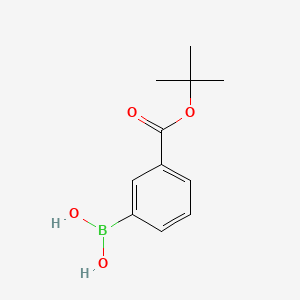
Hangzhou Leap Chem Co., Ltd. is one of the most professional manufacturers and suppliers of (3-((tert-butoxy)carbonyl)phenyl)boronic acid丨cas 220210-56-0 in China. Welcome to wholesale bulk high quality chemical products at competitive price from our factory. If you have any enquiry about custom service, please feel free to email us.
Reliable Supplier (3-((Tert-butoxy)carbonyl)phenyl)boronic acid丨CAS 220210-56-0
Chemical Identifiers
| InChI | 1S/C11H15BO4/c1-11(2,3)16-10(13)8-5-4-6-9(7-8)12(14)15/h4-7,14-15H,1-3H3 |
| InChI Key |
HVJDVHCPCSZDSR-UHFFFAOYSA-N |
| Smiles | OB(C1=CC=CC(C(OC(C)(C)C)=O)=C1)O |
| EC No. | 691-957-9 |
| MDL No. | MFCD01630855 |
| PubChem CID | 2773299 |
Applications
Applications in Suzuki–Miyaura Cross-Coupling Reactions
(3-((tert-Butoxy)carbonyl)phenyl)boronic acid is useful in Suzuki–Miyaura cross-coupling reactions for preparing substituted biaryl and aryl–heteroaryl compounds. Under appropriately optimized palladium-catalyzed conditions, the boronic acid group can react with compatible aryl or heteroaryl halides to form new carbon–carbon bonds. This transformation enables the introduction of a meta-tert-butoxycarbonyl-substituted phenyl fragment into complex molecular structures. The tert-butyl ester may remain intact under suitable coupling conditions, allowing subsequent conversion into a carboxylic acid.
Applications in Medicinal Chemistry
In medicinal chemistry, this compound serves as a building block for preparing aromatic research molecules containing a protected carboxylic acid functionality. Carboxyl-containing aromatic structures are frequently investigated in pharmaceutical discovery because they can influence molecular polarity, hydrogen-bonding interactions, and biological target recognition. The tert-butyl ester provides temporary protection during selected synthetic transformations, while the boronic acid group enables incorporation of the aromatic fragment into larger molecular frameworks. Researchers may use the compound in lead optimization, analog synthesis, and structure–activity relationship studies.
Applications in Pharmaceutical Intermediate Synthesis
(3-((tert-Butoxy)carbonyl)phenyl)boronic acid may support pharmaceutical intermediate synthesis requiring substituted aromatic compounds with a protected carboxyl group. The boronic acid functionality allows carbon–carbon bond formation with suitable coupling partners, while the tert-butyl ester can be retained during compatible synthetic steps. Following construction of the desired aromatic framework, the ester may be cleaved under suitable acidic conditions to generate a free carboxylic acid. The resulting intermediate can undergo further transformations, including amide formation or esterification, depending on the target structure.
Applications in Functionalized Biaryl Synthesis
The compound is particularly useful for constructing biaryl molecules containing a carboxyl-derived functional group. Through suitable cross-coupling reactions, researchers can prepare substituted biphenyls and heterobiaryls with a tert-butyl ester at a defined position. The meta-substitution pattern provides opportunities to investigate how functional group placement influences molecular geometry and chemical properties. Subsequent deprotection enables the preparation of carboxylic acid-functionalized aromatic compounds for further synthetic development.