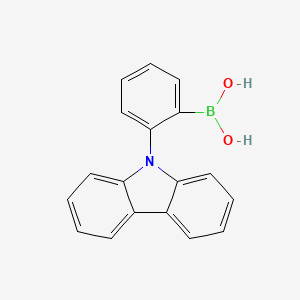
Hangzhou Leap Chem Co., Ltd. is one of the most professional manufacturers and suppliers of 2-(9h-carbazol-9-yl)phenylboronic acid丨cas 1189047-28-6 in China. Welcome to wholesale bulk high quality chemical products at competitive price from our factory. If you have any enquiry about custom service, please feel free to email us.
High Purity 2-(9H-Carbazol-9-yl)phenylboronic Acid丨CAS 1189047-28-6
Chemical Identifiers
| InChI | InChI=1S/C18H14BNO2/c21-19(22)15-9-3-6-12-18(15)20-16-10-4-1-7-13(16)14-8-2-5-11-17(14)20/h1-12,21-22H |
| InChI Key | MBWDMWMXFNHYLL-UHFFFAOYSA-N |
| Smiles | B(C1=CC=CC=C1N2C3=CC=CC=C3C4=CC=CC=C42)(O)O |
| EC No. | 834-346-6 |
| MDL No. | MFCD30543408 |
| PubChem CID | 58121764 |
Applications
Applications in Suzuki–Miyaura Cross-Coupling Reactions
The boronic acid group of 2-(9H-Carbazol-9-yl)phenylboronic acid enables its use in Suzuki–Miyaura cross-coupling reactions with compatible aryl or heteroaryl halides and pseudohalides. Under suitable palladium-catalyzed conditions, this reaction can form new carbon–carbon bonds and produce extended aromatic or heteroaromatic structures. Such transformations are useful for preparing substituted carbazole derivatives, functional molecular building blocks, and conjugated organic compounds. The proximity of the carbazole substituent to the boronic acid group may influence steric accessibility, making appropriate catalyst and reaction-condition selection important.
Applications in OLED Materials Research
2-(9H-Carbazol-9-yl)phenylboronic acid is particularly relevant to research involving organic light-emitting diode (OLED) materials. Carbazole-containing structures are commonly explored in the design of hole-transporting materials, host materials, and other functional components of organic electronic devices. Through suitable synthetic transformations, this compound can be incorporated into larger aromatic frameworks for evaluating charge-transport behavior, energy levels, thermal characteristics, and film-forming properties. Its ortho-substituted structure also provides an opportunity to investigate how molecular geometry affects the performance of carbazole-based materials.
Applications in Organic Semiconductor Research
In organic semiconductor research, carbazole-based compounds are investigated because their nitrogen-containing aromatic frameworks can contribute to useful electronic and optical characteristics. 2-(9H-Carbazol-9-yl)phenylboronic acid can serve as a synthetic precursor for preparing candidate organic semiconductor molecules with tailored aromatic structures. Researchers may use the compound to develop and evaluate materials for charge transport, photophysical studies, and other organic electronic applications. The properties of the resulting materials depend on the complete molecular structure and device configuration.
Applications in Functional Materials and Molecular Design
This compound may also support the synthesis of functional organic materials requiring carbazole-containing aromatic units. Its boronic acid functionality allows researchers to connect the carbazole-substituted phenyl fragment with additional aromatic or heteroaromatic components, enabling systematic modification of molecular size, conjugation, and substitution patterns. These characteristics make it useful in exploratory research involving photoluminescent compounds, functional molecular libraries, and advanced organic materials.