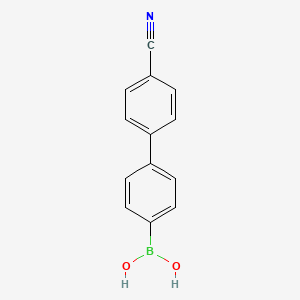
Hangzhou Leap Chem Co., Ltd. is one of the most professional manufacturers and suppliers of b-(4'-cyano(1,1'-biphenyl)-4-yl)boronic acid丨cas 406482-73-3 in China. Welcome to wholesale bulk high quality chemical products at competitive price from our factory. If you have any enquiry about custom service, please feel free to email us.
Bulk Supply B-(4'-Cyano(1,1'-biphenyl)-4-yl)boronic acid丨CAS 406482-73-3
Chemical Identifiers
| InChI | InChI=1S/C13H10BNO2/c15-9-10-1-3-11(4-2-10)12-5-7-13(8-6-12)14(16)17/h1-8,16-17H |
| InChI Key | JYKQRYHFHIAGJD-UHFFFAOYSA-N |
| Smiles | B(C1=CC=C(C=C1)C2=CC=C(C=C2)C#N)(O)O |
| EC No. | |
| MDL No. | MFCD08275641 |
| PubChem CID | 11009573 |
Applications
Applications in Antifungal Treatment
B-(4'-Cyano(1,1'-biphenyl)-4-yl)boronic acid is suitable for Suzuki–Miyaura cross-coupling reactions, which are widely used to construct carbon–carbon bonds between aromatic and heteroaromatic fragments. Under appropriate palladium-catalyzed conditions, its boronic acid group can react with compatible organic halides or pseudohalides to form more complex molecular structures. The existing biphenyl framework allows researchers to introduce a cyano-substituted aromatic unit into extended conjugated systems. This makes the compound useful for preparing substituted oligophenyl derivatives, functional aromatic intermediates, and structurally diverse research molecules.
Applications in Medicinal Chemistry
In medicinal chemistry, this compound may be used as a building block for preparing substituted biphenyl derivatives and investigating structure–activity relationships. The cyano group can influence electronic characteristics, molecular polarity, and interactions with biological targets, depending on the overall structure. The boronic acid functionality provides a convenient route for introducing the cyano-substituted biphenyl fragment into more complex research molecules. Researchers may use this compound in analog synthesis and molecular library development where a defined aromatic framework is required.
Applications in OLED Materials Research
This compound may serve as a synthetic intermediate in research involving organic light-emitting diode (OLED) materials. Biphenyl-based structures are frequently investigated in organic electronic compounds because they can contribute to molecular rigidity and influence electronic characteristics. The cyano group introduces an electron-withdrawing substituent that may affect energy levels and charge distribution in appropriately designed molecules. Through suitable coupling reactions, B-(4'-Cyano(1,1'-biphenyl)-4-yl)boronic acid can be incorporated into larger aromatic frameworks for evaluating their potential as components of organic electronic materials.
Applications in Specialty Organic Synthesis
Beyond pharmaceutical and electronic materials research, B-(4'-Cyano(1,1'-biphenyl)-4-yl)boronic acid is useful in specialty organic synthesis involving functionalized aromatic building blocks. Its boronic acid group supports carbon–carbon bond formation, while the cyano functionality provides an additional site for selected chemical transformations. Under suitable conditions, nitrile groups can be converted into other functional groups, including carboxylic acid or amine derivatives, depending on the desired synthetic route. This combination offers opportunities for preparing complex aromatic intermediates and exploring multistep molecular modification strategies.