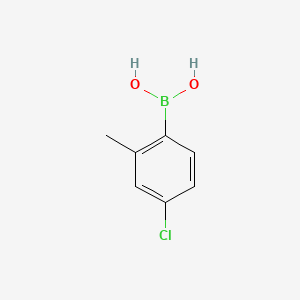
Hangzhou Leap Chem Co., Ltd. is one of the most professional manufacturers and suppliers of (4-chloro-2-methylphenyl)boronic acid丨cas 209919-30-2 in China. Welcome to wholesale bulk high quality chemical products at competitive price from our factory. If you have any enquiry about custom service, please feel free to email us.
Bulk Procurement (4-Chloro-2-methylphenyl)boronic acid丨CAS 209919-30-2
Chemical Identifiers
| InChI | 1S/C7H8BClO2/c1-5-4-6(9)2-3-7(5)8(10)11/h2-4,10-11H,1H3 |
| InChI Key | SRXXSLUUAWHGBZ-UHFFFAOYSA-N |
| Smiles | ClC1=CC(=C(C=C1)B(O)O)C |
| EC No. | 681-532-6 |
| MDL No. | MFCD02683107 |
| PubChem CID | 5017600 |
Applications
Applications in Suzuki–Miyaura Cross-Coupling Reactions
(4-Chloro-2-methylphenyl)boronic acid is useful in Suzuki–Miyaura cross-coupling reactions for preparing substituted biaryl and aryl–heteroaryl compounds. Under appropriately optimized palladium-catalyzed conditions, the boronic acid group can react with compatible aryl or heteroaryl halides to form new carbon–carbon bonds. This transformation enables the introduction of a 4-chloro-2-methylphenyl fragment into larger molecular structures. The chlorine substituent may remain intact under selective reaction conditions, allowing subsequent functionalization. Because the methyl group is positioned adjacent to the boronic acid group, steric effects may influence coupling efficiency and require reaction optimization.
Applications in Medicinal Chemistry
In medicinal chemistry, this compound serves as a building block for preparing substituted aromatic research molecules. Chlorine and methyl substituents can influence molecular lipophilicity, steric interactions, and electronic properties, making them useful for exploring structure–activity relationships. The boronic acid functionality provides a route for incorporating the 4-chloro-2-methylphenyl fragment into candidate compounds. Researchers may use this building block in lead optimization, analog synthesis, and molecular library development.
Applications in Pharmaceutical Intermediate Synthesis
(4-Chloro-2-methylphenyl)boronic acid may support pharmaceutical intermediate synthesis involving chlorinated and methyl-substituted aromatic structures. Through suitable cross-coupling reactions, the compound can be connected to aromatic or heteroaromatic partners to produce advanced intermediates. The chlorine substituent may provide an additional site for selected transition-metal-catalyzed transformations, while the methyl group contributes a defined steric environment. These characteristics support multistep synthetic strategies for preparing structurally diverse pharmaceutical research compounds.
Applications in Agrochemical Research
Chlorinated aromatic compounds are widely investigated in agrochemical chemistry because halogen and alkyl substituents can influence molecular properties and interactions with biological targets. (4-Chloro-2-methylphenyl)boronic acid may serve as an intermediate for preparing research compounds containing a substituted phenyl fragment. Through suitable coupling and functionalization reactions, researchers can develop aromatic or heteroaromatic derivatives for exploratory crop protection research. The biological activity and practical suitability of the resulting compounds depend on their complete molecular structures.