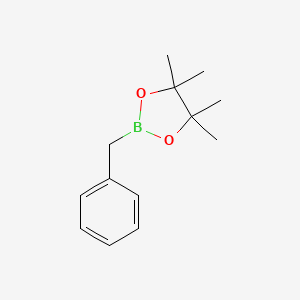
Hangzhou Leap Chem Co., Ltd. is one of the most professional manufacturers and suppliers of 2-benzyl-4,4,5,5-tetramethyl-1,3,2-dioxaborolane丨cas 87100-28-5 in China. Welcome to wholesale bulk high quality chemical products at competitive price from our factory. If you have any enquiry about custom service, please feel free to email us.
Top Selected 2-Benzyl-4,4,5,5-tetramethyl-1,3,2-dioxaborolane丨CAS 87100-28-5
Chemical Identifiers
| InChI | InChI=1S/C13H19BO2/c1-12(2)13(3,4)16-14(15-12)10-11-8-6-5-7-9-11/h5-9H,10H2,1-4H3 |
| InChI Key | YCNQPAVKQPLZRS-UHFFFAOYSA-N |
| Smiles |
B1(OC(C(O1)(C)C)(C)C)CC2=CC=CC=C2 |
| EC No. | 679-569-8 |
| MDL No. | MFCD05663841 |
| PubChem CID | 3864964 |
Applications
Applications in Suzuki–Miyaura Cross-Coupling Reactions
2-Benzyl-4,4,5,5-tetramethyl-1,3,2-dioxaborolane may be used in suitable transition-metal-catalyzed cross-coupling reactions to construct carbon–carbon bonds. Its benzylic boronate functionality provides a route for introducing a benzyl group into compatible aromatic or heteroaromatic coupling partners. Unlike conventional arylboronic acids, benzylic boronate esters may require specifically optimized catalysts, bases, solvents, and reaction conditions to achieve efficient coupling. These transformations are useful for preparing diarylmethane derivatives and other compounds containing a carbon-linked benzyl fragment.
Applications in Medicinal Chemistry
In medicinal chemistry, benzylboronic acid pinacol ester is a useful building block for preparing benzyl-substituted compounds and exploring structure–activity relationships. Benzyl groups are common structural elements in pharmaceutical research because they can influence molecular hydrophobicity, conformational flexibility, and interactions with biological targets. The benzylic carbon–boron bond provides a synthetic handle for introducing this fragment into more complex molecular frameworks. Researchers may use the compound in analog synthesis, lead optimization, and molecular library development to investigate how benzyl substitution affects the properties of candidate molecules.
Applications in Pharmaceutical Intermediate Synthesis
2-Benzyl-4,4,5,5-tetramethyl-1,3,2-dioxaborolane may support the synthesis of pharmaceutical research intermediates containing benzyl or diarylmethane structural units. Through suitable carbon–carbon bond-forming reactions, the benzyl fragment can be incorporated into more complex aromatic and heteroaromatic compounds. The boronate ester functionality also provides opportunities for selected oxidative and other organoboron transformations, depending on the desired synthetic route. These characteristics make the compound useful for investigating alternative synthetic strategies and preparing structurally diverse intermediates for pharmaceutical development.
Applications in Specialty Organic Synthesis
Beyond pharmaceutical research, 2-Benzyl-4,4,5,5-tetramethyl-1,3,2-dioxaborolane can be employed in specialty organic synthesis requiring a versatile benzyl-containing building block. Its organoboron functionality enables selected transformations that may be difficult to achieve through conventional benzyl halide chemistry. Depending on the reaction system, researchers can explore the construction of substituted diarylmethanes, benzylated heterocycles, and other functionalized organic molecules. Its defined structure makes it useful for synthetic methodology development and the preparation of specialized research intermediates.