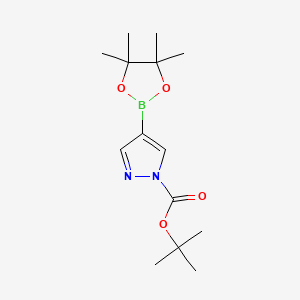
Hangzhou Leap Chem Co., Ltd. is one of the most professional manufacturers and suppliers of tert-butyl 4-(tetramethyl-1,3,2-dioxaborolan-2-yl)-1h-pyrazole-1-carboxylate丨cas 552846-17-0 in China. Welcome to wholesale bulk high quality chemical products at competitive price from our factory. If you have any enquiry about custom service, please feel free to email us.
Purchasing tert-butyl 4-(tetramethyl-1,3,2-dioxaborolan-2-yl)-1H-pyrazole-1-carboxylate丨CAS 552846-17-0
Chemical Identifiers
| InChI | 1S/C14H23BN2O4/c1-12(2,3)19-11(18)17-9-10(8-16-17)15-20-13(4,5)14(6,7)21-15/h8-9H,1-7H3 |
| InChI Key | IPISOFJLWYBCAV-UHFFFAOYSA-N |
| Smiles | C1=C(C=N[N]1C(OC(C)(C)C)=O)B2OC(C(O2)(C)C)(C)C |
| EC No. | 676-377-6 |
| MDL No. | MFCD05663873 |
| PubChem CID | 16217654 |
Applications
Applications in Suzuki–Miyaura Cross-Coupling Reactions
tert-Butyl 4-(tetramethyl-1,3,2-dioxaborolan-2-yl)-1H-pyrazole-1-carboxylate is useful in Suzuki–Miyaura cross-coupling reactions for constructing substituted pyrazole derivatives. Under appropriately optimized palladium-catalyzed conditions, its pinacol boronate functionality can react with compatible aryl or heteroaryl halides and pseudohalides to form new carbon–carbon bonds. This transformation provides a route for introducing an N-protected pyrazol-4-yl fragment into complex molecular frameworks. The Boc protecting group can reduce unwanted reactions involving the pyrazole nitrogen, although its compatibility with the selected coupling conditions should be evaluated. Reaction optimization may be necessary because heteroarylboronate esters can exhibit substrate-dependent stability and coupling efficiency.
Applications in Medicinal Chemistry
In medicinal chemistry, this compound serves as a building block for preparing pyrazole-containing research molecules and exploring structure–activity relationships. Pyrazole rings are frequently investigated in pharmaceutical discovery because their nitrogen-containing aromatic structures can influence molecular polarity, hydrogen-bonding interactions, and biological target recognition. The boronate ester group enables the incorporation of the pyrazole fragment into diverse aromatic and heteroaromatic frameworks. Meanwhile, the Boc group provides a temporary protecting strategy that may facilitate multistep synthesis. Researchers may use this compound in lead optimization, analog preparation, and molecular library development.
Applications in Pharmaceutical Intermediate Synthesis
tert-Butyl 4-(tetramethyl-1,3,2-dioxaborolan-2-yl)-1H-pyrazole-1-carboxylate may support pharmaceutical research programs requiring intermediates containing a substituted pyrazole structural unit. Its boronate ester functionality provides a convenient route for constructing carbon–carbon bonds with suitable coupling partners. Following the desired synthetic transformation, the Boc protecting group may be removed under appropriately selected conditions to obtain a pyrazole derivative with an available ring nitrogen. This sequence offers flexibility for preparing compounds that require both substitution at the 4-position and subsequent nitrogen functionalization. The compound is therefore useful for developing multistep synthetic routes and structurally diverse pharmaceutical research intermediates.
Applications in Heterocyclic Chemistry
This compound is particularly relevant to heterocyclic chemistry because it combines a protected pyrazole ring with a reactive organoboron functionality. The pyrazole framework provides a compact five-membered aromatic heterocycle containing two adjacent nitrogen atoms, while the boronate ester group supports selected carbon–carbon bond-forming transformations. Researchers may use the compound to prepare 4-substituted pyrazoles, biheteroaryl molecules, and other nitrogen-containing aromatic structures. Its protected nitrogen functionality also makes it useful for investigating reaction selectivity and protecting-group strategies in heterocyclic synthesis.