

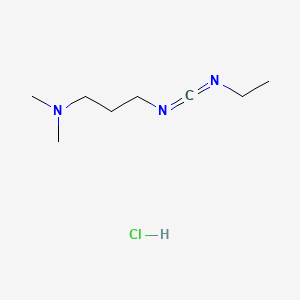
Hangzhou Leap Chem Co., Ltd. is one of the most professional manufacturers and suppliers of 1-(3-dimethylaminopropyl)-3-ethylcarbodiimide hydrochloride丨cas 25952-53-8 in China. Welcome to wholesale bulk high quality chemical products at competitive price from our factory. If you have any enquiry about custom service, please feel free to email us.
Specifications
|
Appearance |
White or off-white crystalline powder |
|
Assay |
99% min |
|
Melting Point |
104 – 114 °C |
|
Water |
1.0% max |
Transport Information
|
Parameter |
Specification |
|
UN Number |
2811 |
|
Class |
6.1 |
|
Packing Group |
III |
|
H.S. Code |
2925190090999 |
|
Stability & Reactivity |
The product is chemically stable under standard ambient conditions. |
|
Storage |
Tightly closed. Store in a closed, dry, ventilated place |
|
Condition to Avoid |
|
|
Package |
Manufacturing Information
|
Parameter |
Specification |
|
Capacity |
100MT/year |
|
Frequency |
|
|
Main Export Countries |
|
|
Capacity/Batch |
|
|
Experience |
|
|
Stock |
Introduction
1-(3-Dimethylaminopropyl)-3-ethylcarbodiimide hydrochloride丨CAS 25952-53-8 (also called EDCI or simply EDC) is a water-soluble carbodiimide reagent widely used in organic synthesis and bioconjugation chemistry. Its primary role is to facilitate amide bond formation between carboxyl and amine groups, making it an essential reagent in peptide synthesis, protein labeling, and surface modifications.
Compared to other carbodiimide reagents such as DCC (dicyclohexylcarbodiimide), EDC is water-soluble and produces water-soluble urea byproducts, making purification easier and more environmentally friendly.
Key Applications
1. Peptide Synthesis
EDC is extensively used for solid-phase and solution-phase peptide synthesis. It activates carboxylic acids to form amide bonds with amines:
● Often combined with N-hydroxysuccinimide (NHS) or Sulfo-NHS to improve reaction efficiency and yield.
● Suitable for aqueous and organic media.
2. Protein and Antibody Crosslinking
EDC enables zero-length crosslinking of proteins, antibodies, or peptides by directly forming amide bonds between carboxyl and amine residues:
● Used in bioconjugate chemistry for preparing enzyme-linked antibodies, fluorescently tagged proteins, or immobilized enzymes.
● Maintains protein functionality due to mild reaction conditions.
3. Surface and Nanoparticle Functionalization
EDC is used to immobilize biomolecules onto various surfaces (e.g., magnetic beads, nanoparticles, glass slides):
● Common in biosensors, microarrays, and drug delivery systems.
● Enables covalent bonding of carboxyl-functionalized surfaces with amine-containing ligands.
4. Polymer Chemistry
EDC mediates post-functionalization of polymers containing carboxylic acid or amine groups:
● Used in the production of hydrogels, smart polymers, and bioactive coatings.
● Facilitates the development of biocompatible and targeted materials.
5. Oligonucleotide and DNA Conjugation
EDC is widely used in nucleic acid chemistry to link oligonucleotides with reporters, proteins, or drug molecules:
● Especially useful in RNA labeling, probe immobilization, and DNA-protein conjugates.
6. Pharmaceutical and Biomedical Research
● Plays a key role in synthesizing drug candidates and targeted delivery vehicles.
● Used in controlled release systems and PEGylation of drugs for improved solubility and bioavailability.
Advantages and Benefits
1. Water-Soluble and Easy to Remove
● Unlike DCC, 1-(3-Dimethylaminopropyl)-3-ethylcarbodiimide hydrochloride丨CAS 25952-53-8 and its urea byproducts are water-soluble, allowing for simple aqueous workup and fewer purification steps.
2. Mild and Efficient
● Reactions typically occur at room temperature, under mild pH conditions (pH 4.5–7.5).
● Suitable for sensitive biomolecules like proteins and nucleic acids.
3. No Spacer Molecule Required
● Enables direct (zero-length) coupling, forming stable covalent bonds without introducing linkers.
● Ideal for applications where compact labeling or direct functionalization is desired.
4. Broad Compatibility
● Effective in both aqueous and organic solvents (e.g., DMF, DMSO, water).
● Can be used with a wide range of substrates: peptides, proteins, polymers, DNA, nanoparticles, and small molecules.
5. Green and Scalable
● Generates less hazardous waste than traditional coupling agents.
● Useful in both laboratory and industrial-scale synthesis.
Conclusion
1-(3-Dimethylaminopropyl)-3-ethylcarbodiimide hydrochloride丨CAS 25952-53-8 is a powerful, water-soluble coupling agent widely used in bioconjugation, peptide synthesis, polymer functionalization, and surface modification. Its ability to form direct amide bonds under mild, aqueous conditions makes it ideal for biological and pharmaceutical applications.
Thanks to its low toxicity, water solubility, and high efficiency, EDC remains a cornerstone reagent in both academic and industrial chemistry for creating biofunctional materials, diagnostics, and drug delivery systems.


