

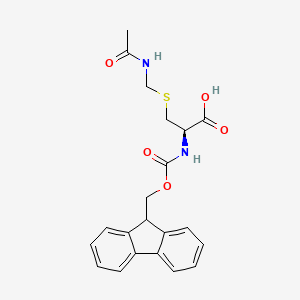
Hangzhou Leap Chem Co., Ltd. is one of the most professional manufacturers and suppliers of fmoc-s-acetamidomethyl-l-cysteine丨cas 86060-81-3 in China. Welcome to wholesale bulk high quality chemical products at competitive price from our factory. If you have any enquiry about custom service, please feel free to email us.
Specifications of Fmoc-S-acetamidomethyl-L-cysteine丨CAS 86060-81-3
|
Appearance: |
White to off-White powder |
|
Purity (HPLC): |
98.5% min |
|
Specific Rotation: |
-32.0° ± 3° (c=1, in MeOH) |
|
Optical Purity: |
≤ 0.30% D-enantiomer |
|
Solubility: |
1 mmol in 2 ml DMF, clearly soluble |
|
Water Content (K.F.): |
1.0% max |
|
IR Spectrum: |
In accordance with the structure |
Overview
Fmoc-S-acetamidomethyl-L-cysteine丨CAS 86060-81-3 is a specialized amino acid derivative that is widely used in the synthesis of peptides and bioconjugates in biochemistry and pharmaceutical research.
Applications of Fmoc-S-acetamidomethyl-L-cysteine丨CAS 86060-81-3
1. Peptide Synthesis
A. Amino Acid Protecting Group
● Fmoc Group: The Fmoc group (9-fluorenylmethyloxycarbonyl) is commonly used as a protecting group for the amino group during solid-phase peptide synthesis (SPPS). It provides selective protection, allowing the assembly of complex peptides by preventing undesired reactions at the amino group.
● Thiol Protection: The acetamidomethyl (AAM) group is used to protect the thiol (-SH) of cysteine during peptide synthesis. This is crucial as cysteine's thiol group can otherwise lead to undesirable disulfide formation or side reactions during the synthesis process.
B. Synthesis of Disulfide-Containing Peptides
● After peptide synthesis, the Fmoc group can be removed, and the acetyl protection can be cleaved to expose the cysteine's thiol group, which can then participate in forming disulfide bridges in peptides and proteins, important for tertiary structure formation.
● This feature is particularly valuable when designing cyclic peptides or protein mimetics that require precise control over the disulfide linkage.
2. Research in Protein Engineering and Structural Biology
● Disulfide Bond Formation: This derivative is useful in studies related to disulfide bond formation in peptides or proteins, essential for structural integrity and function. It helps in the design of peptides or proteins that must undergo oxidative folding to stabilize their 3D structure.
● Molecular Modeling: Useful in computational biology and structural modeling, where it aids in designing peptides that require specific thiol handling or reduction-oxidation processes.
3. Bioconjugation
● Used in the conjugation of peptides with biomolecules (e.g., antibodies, enzymes, or fluorescent dyes), where controlling the reactivity of the thiol group is crucial. The acetamidomethyl group can be selectively removed to enable conjugation without affecting other components in the complex.
4. Drug Development and Peptide-Based Therapeutics
● Peptide Drug Design: Fmoc-S-acetamidomethyl-L-cysteine is involved in the synthesis of peptide-based drugs where precise control over cysteine residue modifications is important. This can help develop therapeutics that rely on cysteine's reactivity, including antioxidants, enzymes, or hormone mimetics.
Benefits of Fmoc-S-acetamidomethyl-L-cysteine丨CAS 86060-81-3
1. Efficient Peptide Synthesis
● Fmoc-S-acetamidomethyl-L-cysteine丨CAS 86060-81-3 provides a reliable method for protecting the amino and thiol groups of cysteine during solid-phase synthesis. This allows for the synthesis of peptides with high purity and selectivity.
2. Flexibility in Disulfide Bond Formation
● Its removable protection groups (Fmoc and AAM) allow for controlled disulfide bond formation, essential for stabilizing complex peptide and protein structures, especially when synthesizing cyclic peptides.
3. Stability and Handling
● The Fmoc protection allows for stable handling during peptide synthesis, while the acetaminomethyl group ensures that cysteine's thiol group is protected from unwanted reactions during the early stages of synthesis.
4. Compatibility with Automated Systems
● It is compatible with automated peptide synthesizers, making it highly valuable for high-throughput peptide synthesis in drug discovery and peptide library generation.
5. Enables Controlled Peptide Functionalization
● Once the protective groups are removed, the free thiol group can be used to introduce functional groups or biomolecular labels, enabling the design of highly functionalized or conjugated peptides.
Conclusion
Fmoc-S-acetamidomethyl-L-cysteine丨CAS 86060-81-3 is a specialized amino acid derivative with applications in peptide synthesis, particularly for cysteine-containing peptides. Its use as a protecting group for both the amino and thiol groups enables the synthesis of complex peptides with disulfide bonds, making it indispensable in the fields of biochemistry, drug development, and structural biology. This compound facilitates precise control over cysteine chemistry and peptide folding, enhancing the development of peptide-based therapeutics and bioconjugates.




