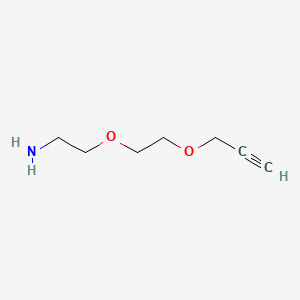
Hangzhou Leap Chem Co., Ltd. is one of the most professional manufacturers and suppliers of h2n-peg2-propyne丨cas 944561-44-8 in China. Welcome to wholesale bulk high quality chemical products at competitive price from our factory. If you have any enquiry about custom service, please feel free to email us.
Specifications
| Appearance | Colorless clear liquid |
| Purity | 97% min |
| Homologue impurity | 0.5% max |
Transport Information
|
Parameter |
Specification |
|
UN Number |
2735 |
|
Class |
8 |
|
Packing Group |
II |
|
H.S. Code |
2922299090999 |
|
Stability & Reactivity |
The product is chemically stable under standard ambient conditions. |
|
Storage |
Keep the container sealed. Store in the refrigerator. |
|
Condition to Avoid |
Heating. Electrical sparks and open flames are exposed to the air. |
|
Package |
Applications
H₂N-PEG₂-Propyne is primarily used as a functional linker in bioconjugation and chemical biology research. Its structure combines a short polyethylene glycol (PEG₂) spacer with a terminal alkyne (propyne) and a primary amine group, making it suitable for dual-functional modification of biomolecules. It is commonly applied in the synthesis of PEGylated peptides, proteins, and small molecules, as well as in click chemistry reactions such as copper-catalyzed azide-alkyne cycloaddition (CuAAC) to attach labels, probes, or therapeutic payloads. This compound is valuable in drug development, molecular imaging, and diagnostic applications, where precise attachment of functional groups or biomolecules is required. It also serves as a building block for preparing multifunctional linkers and surface-modified materials with tailored properties.
Benefits
H₂N-PEG₂-Propyne provides significant benefits due to its dual-reactive functionality and short PEG spacer. The primary amine allows for conventional amide coupling reactions with carboxylic acids, while the terminal alkyne enables selective click chemistry conjugation under mild conditions. The PEG₂ chain enhances solubility, reduces steric hindrance, and imparts biocompatibility, improving the behavior of modified biomolecules in aqueous environments. Its chemical stability and well-defined structure ensure reproducibility in synthesis and bioconjugation, enabling the efficient production of high-purity, functionally optimized molecules. Overall, it facilitates precise and versatile modifications, enhancing the performance of PEGylated or labeled compounds in research and therapeutic applications.
Conclusion
H₂N-PEG₂-Propyne is a versatile and valuable linker for bioconjugation and chemical biology. Its combination of a primary amine, terminal alkyne, and short PEG₂ spacer enables dual functionalization, click chemistry, and improved solubility of modified biomolecules. By providing a reliable and adaptable platform for PEGylation, labeling, and molecular modification, it supports the development of advanced therapeutics, probes, and functional biomaterials in pharmaceutical research and diagnostics.


![[2-[2-(Fmoc-amino)ethoxy]ethoxy]acetic Acid丨CAS 166108-71-0](/uploads/42644/small/2-2-fmoc-amino-ethoxy-ethoxy-acetic-acid-cas58f15.png)