

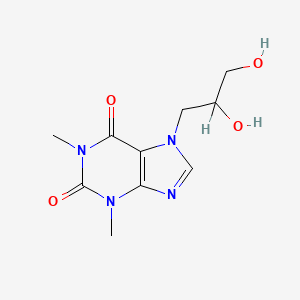
Hangzhou Leap Chem Co., Ltd. is one of the most professional manufacturers and suppliers of diprophylline丨cas 479-18-5 in China. Welcome to wholesale bulk high quality chemical products at competitive price from our factory. If you have any enquiry about custom service, please feel free to email us.
Specifications
| Appearance: | White powder or particle; odorless |
| Assay (On dried basis): | 98% min |
| Solubility: | Easily soluble in water, slightly soluble in ethanol, extremely slightly soluble in chloroform or ether |
| Melting Point: | 160~164 °C |
| Absorption: | 354~376 |
| Solution: | Clear and colourless |
| Clarity of Solution: | 0.5# max |
| Chlorides: | 0.028% max |
| Theophylline: | 0.5% max |
| Total Other Impurities: | 0.5% max |
| Loss on Drying: | 0.5% max |
| Residue on Ignition: | 0.15% max |
| Heavy Metals: | 20 ppm max |
Applications
Diprophylline (CAS 479-18-5) is a xanthine derivative commonly used in the treatment of respiratory conditions such as asthma, chronic bronchitis, and other obstructive airway diseases. It acts as a bronchodilator, helping to relax the smooth muscles of the airways and improve airflow. In clinical settings, diprophylline is administered orally or intravenously for its therapeutic effects in managing bronchospasm and enhancing respiratory function. Beyond direct treatment, it is also utilized in pharmaceutical research as a reference compound for studying xanthine derivatives, their pharmacokinetics, and their mechanisms of action in the respiratory and cardiovascular systems.
Benefits
The benefits of diprophylline are attributed to its dual action as a bronchodilator and mild diuretic with lower cardiac and central nervous system stimulation compared to other xanthines like theophylline. This makes it safer and better tolerated in patients, particularly those sensitive to side effects such as tachycardia or nervousness. It effectively relieves bronchospasm, improves oxygenation, and reduces symptoms of wheezing and shortness of breath. Its predictable pharmacokinetic profile and relatively low toxicity allow for flexible dosing and long-term management of respiratory disorders. Additionally, its use in research supports the development of safer and more effective xanthine-based therapeutics.
Conclusion
Diprophylline is a clinically valuable xanthine derivative with important applications in treating asthma and other obstructive respiratory conditions. Its bronchodilatory effects, combined with lower side effects and favorable tolerability, make it a preferred choice for patient management. By improving airway function and supporting respiratory health, diprophylline continues to play a significant role in both clinical therapy and pharmaceutical research.


