Hangzhou Leap Chem Co., Ltd. is one of the most professional manufacturers and suppliers of edc hydrochloride丨cas 25952-53-8 in China. Welcome to wholesale bulk high quality chemical products at competitive price from our factory. If you have any enquiry about custom service, please feel free to email us.
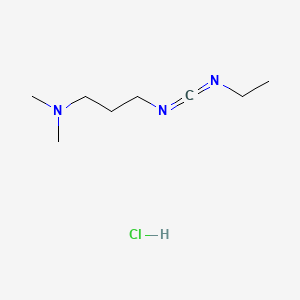
High Purity EDC hydrochloride丨CAS 25952-53-8
Chemical Identifiers
| InChI | InChI=1S/C8H17N3.ClH/c1-4-9-8-10-6-5-7-11(2)3;/h4-7H2,1-3H3;1H |
| InChI Key | FPQQSJJWHUJYPU-UHFFFAOYSA-N |
| Smiles | CCN=C=NCCCN(C)C.Cl |
| EC No. | 247-361-2 |
| MDL No. | MFCD00012503 |
| PubChem CID | 2723939 |
Applications
Peptide Synthesis and Amide Bond Formation
EDC Hydrochloride is commonly used to promote peptide bond formation and the coupling of carboxylic acids with amines. In peptide synthesis and related research, it supports the preparation of peptides, modified amino acids, and other amide-containing compounds. Reaction conditions and, where appropriate, coupling additives can be optimized to improve efficiency and limit unwanted side reactions.
Pharmaceutical Research and Drug Discovery
In pharmaceutical research, EDC Hydrochloride can support the synthesis of amide-containing intermediates, molecular conjugates, and specialized compounds for drug discovery. Researchers may use it during synthetic route development, molecular functionalization, and the preparation of structures for biological evaluation. Its suitability depends on the target molecule, substrate compatibility, and requirements for purification and impurity control.
Bioconjugation and Biomolecule Modification
Surface Functionalization and Materials Science
EDC·HCl is used in selected materials research workflows to facilitate the attachment of molecules to carboxyl-functionalized surfaces or particles. It can support the preparation of functionalized polymers, biomaterial surfaces, and research materials designed for molecular recognition or immobilization studies. Applications may include laboratory investigations involving biosensors, separation materials, and surface-bound biomolecules.