Hangzhou Leap Chem Co., Ltd. is one of the most professional manufacturers and suppliers of diisopropylcarbodiimide丨cas 693-13-0 in China. Welcome to wholesale bulk high quality chemical products at competitive price from our factory. If you have any enquiry about custom service, please feel free to email us.
Custom Synthesis Diisopropylcarbodiimide丨CAS 693-13-0
Chemical Identifiers
| InChI | InChI=1S/C7H14N2/c1-6(2)8-5-9-7(3)4/h6-7H,1-4H3 |
| InChI Key | BDNKZNFMNDZQMI-UHFFFAOYSA-N |
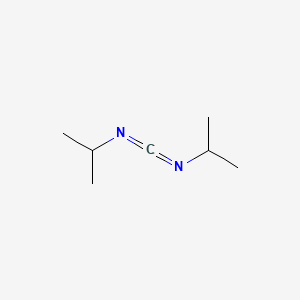
| Smiles | CC(C)N=C=NC(C)C |
| EC No. | 211-743-7 |
| MDL No. | MFCD00065689 |
| PubChem CID | 12734 |
Applications
Peptide Synthesis and Peptide Chemistry
Diisopropylcarbodiimide is commonly used as a coupling reagent in peptide synthesis to facilitate the formation of amide bonds between amino acids. It can be used in both solution-phase and solid-phase peptide synthesis, often alongside additives selected to improve coupling efficiency and manage side reactions. Its role in peptide bond formation makes it relevant to research involving synthetic peptides, modified peptide sequences, and peptide-based compounds.
Pharmaceutical Research and Drug Discovery
In pharmaceutical research, DIC supports the synthesis of amide-containing compounds and intermediates used in medicinal chemistry. Researchers can apply it in reaction development and the preparation of candidate molecules to investigate structure–activity relationships and optimize synthetic routes. Its suitability for a particular process depends on the substrate, reaction conditions, and impurity-control requirements.
Organic Synthesis and Amide Bond Formation
Chemical Intermediates and Specialty Molecules
Diisopropylcarbodiimide may be incorporated into synthetic workflows for preparing specialty chemicals, functional materials, and research compounds that require controlled bond formation. It is useful where reliable carboxyl-group activation is needed, although reaction optimization and appropriate work-up procedures remain important for controlling by-products and achieving the required purity.