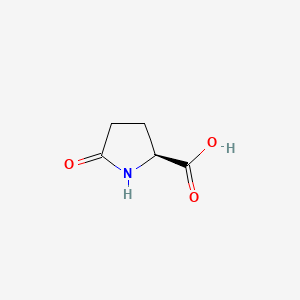
Hangzhou Leap Chem Co., Ltd. is one of the most professional manufacturers and suppliers of l-pyroglutamic acid丨cas 98-79-3 in China. Welcome to wholesale bulk high quality chemical products at competitive price from our factory. If you have any enquiry about custom service, please feel free to email us.
Specifications
|
Grade |
AJI92 |
|
Appearance |
White Crystals |
|
Assay |
98.5% ~ 101.0% |
|
Specific rotation (α)D20, C=5 H2O |
-10.5° to -12.0° |
|
Transmittance |
98% min |
|
Melting Point |
159℃ ~ 162℃ |
|
Chloride (Cl) |
0.02% max |
|
Ammonium (NH4) |
0.02% max |
|
Sulfate (SO4) |
0.02% max |
|
Heavy metals (Pb) |
10 ppm max |
|
Iron (Fe) |
10 ppm max |
|
Arsenic (As2O3) |
1 ppm max |
|
Loss on drying (105℃, 2h) |
0.5% max |
|
Residue on ignition |
0.1% max |
Applications
1. Pharmaceutical Industry
L-Pyroglutamic acid丨CAS 98-79-3 is used as:
An intermediate in drug synthesis, especially for nootropic (cognitive-enhancing) agents.
A metabolite in the γ-glutamyl cycle, making it useful in research on glutathione metabolism and oxidative stress.
A structural motif in peptide and protein design, as N-terminal pyroglutamyl residues improve proteolytic stability.
Some derivatives or analogs of pyroglutamic acid are explored for:
Memory-enhancing drugs
Neuroprotective agents
Anti-aging formulations
2. Cosmetics and Personal Care
Moisturizer and humectant: L-Pyroglutamic acid is a natural component of the skin's natural moisturizing factor (NMF). Its sodium salt (sodium PCA) is widely used in:
Skin creams
Shampoos
Hair conditioners
Serums and facial mists
It helps to retain moisture, improve skin elasticity, and restore skin barrier function.
3. Nutritional and Biomedical Research
In biomedical research, L-pyroglutamic acid is studied as a biomarker of oxidative stress or metabolic imbalance.
It's also a precursor or degradation product of glutamine and glutathione, important in amino acid metabolism and antioxidant defense.
Used in research involving protein degradation and N-terminal blocking in peptides.
4. Peptide Synthesis and Biotechnology
L-Pyroglutamic acid is frequently used to block the N-terminus of peptides during synthesis, preventing degradation and enhancing biological half-life.
Important in protein engineering for structural stabilization.
Pyroglutamylation occurs naturally in many proteins and peptides, influencing their activity, stability, and immunogenicity.
5. Food and Flavoring Industry
Although less common, pyroglutamic acid and derivatives may be formed during protein hydrolysis or Maillard reactions, contributing to flavor complexity in cooked or fermented foods.
Benefits
✅ 1. Natural and Biocompatible
L-Pyroglutamic acid is a naturally occurring amino acid derivative, present in the human body and in dietary proteins.
As such, it's non-toxic, biodegradable, and suitable for use in nutraceuticals and cosmetics.
✅ 2. Enhances Moisture Retention
As a precursor to sodium PCA, it plays a key role in maintaining skin hydration.
Helps reduce trans-epidermal water loss (TEWL) and strengthens the skin barrier.
✅ 3. Improves Peptide Stability
Pyroglutamyl residues can protect peptides from enzymatic degradation, improving their stability and bioavailability.
This makes it useful in drug delivery systems, especially for peptide-based therapeutics.
✅ 4. Supports Neurological and Cognitive Function
Certain derivatives of L-pyroglutamic acid are investigated for cognitive enhancement, particularly in aging populations or neurodegenerative conditions.
It may support acetylcholine regulation and glutamate neurotransmission.
✅ 5. Key Role in Metabolism
L-Pyroglutamic acid is involved in the glutathione cycle, making it relevant in research on:
Cellular detoxification
Oxidative stress responses
Amino acid recycling
✅ 6. Versatile Intermediate
It serves as a synthetic building block in organic synthesis, pharmaceuticals, and biotechnology, offering chemical stability and functionality (lactam, carboxylic acid).
Summary
L-Pyroglutamic acid丨CAS 98-79-3 is a cyclic amino acid derivative with applications spanning pharmaceuticals, cosmetics, biomedical research, and peptide synthesis. Known for its moisturizing and stabilizing properties, it plays a key role in skin hydration, drug development, and metabolic pathways. As a naturally occurring compound with excellent biocompatibility, it offers versatility and safety, making it highly valuable across life sciences and applied chemistry fields.