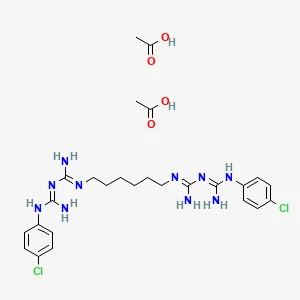

Hangzhou Leap Chem Co., Ltd. is one of the most professional manufacturers and suppliers of coenzyme a丨cas 85-61-0 in China. Welcome to wholesale bulk high quality chemical products at competitive price from our factory. If you have any enquiry about custom service, please feel free to email us.
Specifications of Coenzyme A丨CAS 85-61-0
|
Appearance: |
White or slightly yellow powder |
|
Identification: |
Abs: 258nm min |
|
Abs: |
230max |
|
Clarity and color of solution: |
Conforms |
|
Homogeneity: |
Conforms |
|
Related substances: |
15.0% min |
|
Residual organic solvents: |
Conforms |
|
Loss on drying: |
5.0% max |
|
Bacterial endotoxin: |
The amount of endotoxin per unit of coenzyme A 0.25EU max |
|
Total bacteria count: |
1000 cfu/g max |
|
Yeast and moulds count: |
100 cfu/g max |
|
Escherichia coli: |
Absent |
|
Potency determination (on dried basis): |
250 u/mg min (1 mg coenzyme A) |
Transport Information of Coenzyme A丨CAS 85-61-0
|
Parameter |
Specification |
|
UN Number |
|
|
Class |
|
|
Packing Group |
|
|
H.S. Code |
2934999099304 |
|
Stability & Reactivity |
The product is chemically stable under standard ambient conditions (room temperature). |
|
Storage |
Tightly closed. Dry. -80 °C |
|
Condition to Avoid |
|
|
Package |
Manufacturing Information of Coenzyme A丨CAS 85-61-0
|
Parameter |
Specification |
|
Capacity |
1MT/year |
|
Frequency |
|
|
Main Export Countries |
|
|
Capacity/Batch |
|
|
Experience |
Production since 2015 |
|
Stock |
Overview
Coenzyme A丨CAS 85-61-0 is a vitamin B5-derived essential cofactor in various biochemical reactions, playing a central role in the metabolism of fatty acids, carbohydrates, and amino acids. It functions as a carrier for acyl groups (such as acetyl groups) in the form of acyl-CoA complexes, facilitating a broad range of biological processes.
Applications of Coenzyme A丨CAS 85-61-0
1. Biochemistry and Molecular Biology
a. Metabolic Studies and Research
● Coenzyme A is indispensable in research into cellular metabolism, bioenergetics, and enzyme kinetics.
● It serves as a key component in studying pathways like fatty acid oxidation, citric acid cycle (Krebs cycle), and protein modification (e.g., acetylation).
● Used in laboratory settings to explore enzyme-substrate interactions, metabolic disorders, and the regulation of biosynthetic pathways.
b. CoA Analog Synthesis
● Coenzyme A analogs are often synthesized to understand enzyme regulation and enzyme inhibition mechanisms.
● These analogs are also employed in drug development, particularly in cancer research, where CoA analogs inhibit specific enzymes involved in cell division.
2. Pharmaceutical Industry
a. Coenzyme A in Drug Development
● Coenzyme A丨CAS 85-61-0 derivatives and analogs are being studied for their potential in treating metabolic diseases, cancer, and infections.
● Acyl-CoA synthetase inhibitors, which block the activation of fatty acids to acyl-CoA, are being developed as anti-cancer agents because they can block fatty acid metabolism in rapidly dividing cells.
b. Fatty Acid Metabolism Modulation
● Coenzyme A is integral in the synthesis and breakdown of fatty acids. Modulating its pathways can have applications in obesity treatment, diabetes management, and cardiovascular health.
● Acetyl-CoA plays a role in regulating cholesterol synthesis, making it relevant for studies on lipid disorders.
3. Cosmetics and Skincare
a. Anti-Aging and Skin Health
● Coenzyme A's role in cellular energy production and fatty acid metabolism makes it an interesting ingredient for anti-aging products.
● It is often found in anti-aging creams, serums, and moisturizers, where it helps in regenerating skin cells, improving skin elasticity, and promoting collagen production.
b. Cellular Regeneration
● Coenzyme A, particularly in its active form, influences the synthesis of lipids, which are important for maintaining skin hydration and barrier function.
● It is also involved in ATP production, which is critical for energy-dependent processes like skin renewal and repair.
4. Agriculture and Plant Biology
a. Plant Metabolism and Growth
● Coenzyme A plays an essential role in the metabolism of fatty acids in plants, influencing processes like seed development and germination.
● It is involved in plant biosynthesis, including the formation of flavonoids and alkaloids, both of which have antioxidant and antimicrobial properties.
● Understanding CoA metabolism in plants can assist in crop improvement by optimizing oil production and stress tolerance.
5. Biotechnology and Bioengineering
a. Biocatalysis
● Coenzyme A丨CAS 85-61-0 is essential for enzymatic reactions in biotechnological applications, particularly in biotransformations and bioengineering.
● It is used in enzyme-based production systems for generating metabolites like acetyl-CoA, which are crucial for the production of biofuels, pharmaceuticals, and bioplastics.
b. Microbial Fermentation
● CoA and its derivatives are used in microbial fermentation processes where microorganisms synthesize CoA-dependent metabolites, such as acetyl-CoA.
● These fermentation processes are critical in producing bio-based chemicals like acetate or propionate.
Benefits of Coenzyme A丨CAS 85-61-0
1. Essential for Cellular Metabolism
● Coenzyme A丨CAS 85-61-0 is crucial in energy metabolism, participating in the oxidation of fatty acids and the citric acid cycle (Krebs cycle), which generates ATP-the energy currency of cells.
● It is indispensable for the synthesis of several key biomolecules, including lipids, steroids, and vitamin A.
2. Central Role in Fatty Acid Metabolism
● CoA derivatives, particularly acetyl-CoA, are involved in fatty acid biosynthesis and catabolism, making CoA critical in regulating fat storage, energy production, and lipid homeostasis.
● This has implications for weight management, metabolic health, and cardiovascular disease prevention.
3. Impact on Gene Regulation and Epigenetics
● Coenzyme A plays a vital role in the acetylation of proteins, influencing histone modification and gene expression, thus impacting epigenetic regulation.
● The acetylation process is essential for cell cycle control, cell differentiation, and aging.
4. Coenzyme A in Drug Development
● CoA analogs have shown potential as antibacterial and anticancer agents by targeting enzymes involved in cellular energy production and biosynthetic pathways.
● As an inhibitor or substrate analog, CoA plays a crucial role in drug discovery targeting metabolic pathways involved in diseases like cancer, metabolic disorders, and infections.
5. Antioxidant and Anti-Aging Benefits
● Coenzyme A's role in energy production and lipid metabolism helps maintain cell vitality and protect against oxidative stress-a key contributor to aging and degenerative diseases.
● It supports the production of glutathione, a critical antioxidant, protecting cells from damage and improving skin health.
Conclusion
Coenzyme A丨CAS 85-61-0 is a vital biochemical cofactor, essential for a wide range of metabolic and cellular processes. From cellular energy production to fatty acid metabolism, lipid biosynthesis, and gene regulation, CoA plays a central role in maintaining cellular health and homeostasis.