

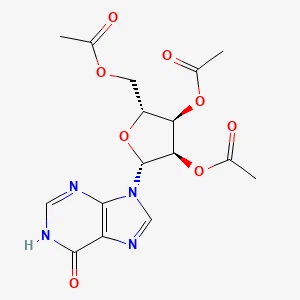
Hangzhou Leap Chem Co., Ltd. is one of the most professional manufacturers and suppliers of 2,3,5-triacetylinosine丨cas 3181-38-2 in China. Welcome to wholesale bulk high quality chemical products at competitive price from our factory. If you have any enquiry about custom service, please feel free to email us.
Specifications
|
Appearance |
White to off-white powder |
|
Purity (by HPLC) |
97% min |
|
Loss on drying |
1% max |
Overview
2,3,5-Triacetylinosine丨CAS 3181-38-2 is a modified nucleoside used primarily as a prodrug or intermediate in pharmaceutical and biochemical applications. The acetyl groups increase the molecule's lipophilicity, enhancing its cell membrane permeability compared to inosine.
Applications
1. Prodrug in Antiviral and Anticancer Research
Acts as a prodrug to inosine, which is involved in many physiological processes including nucleic acid metabolism and immune response.
The acetylation improves oral bioavailability and cellular uptake, making it a useful compound in drug design, particularly for antiviral and anticancer agents.
2. Pharmaceutical Intermediate
Used in the synthesis of modified nucleosides and nucleotides for developing therapeutic agents targeting viral infections or cancers.
3. Research Tool
Employed in biochemical studies to explore nucleoside metabolism, transport mechanisms, and drug delivery systems.
Benefits
✅ Improved Bioavailability
Acetylation enhances lipophilicity, promoting better absorption and cellular uptake.
✅ Prodrug Strategy
Serves as a precursor that releases inosine in vivo, potentially minimizing side effects while maximizing efficacy.
✅ Versatile Intermediate
Useful for synthesizing diverse nucleoside analogs with various therapeutic potentials.
✅ Enhanced Stability
Acetyl groups protect the molecule from premature metabolism, increasing chemical stability during formulation and delivery.
Summary
2,3,5-Triacetylinosine丨CAS 3181-38-2 is a triacetylated inosine derivative that functions primarily as a prodrug and pharmaceutical intermediate. Its increased lipophilicity and stability make it valuable in drug development, especially for enhancing delivery and bioavailability of nucleoside-based therapies.


