

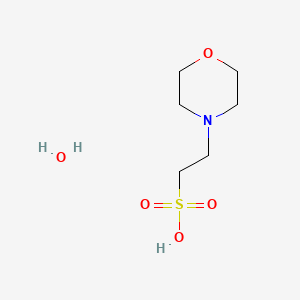
Hangzhou Leap Chem Co., Ltd. is one of the most professional manufacturers and suppliers of mes monohydrate丨cas 145224-94-8 in China. Welcome to wholesale bulk high quality chemical products at competitive price from our factory. If you have any enquiry about custom service, please feel free to email us.
Specifications of MES monohydrate丨145224-94-8
|
Property |
Specification |
|
Appearance |
White crystalline powder |
|
Assay (T) |
99% - 101% |
|
Water |
8.9% max |
|
Loss on drying |
10% max |
|
Solution (1% aqueous) |
Colorless and clear |
|
pH (1M aqueous) |
3.5 - 4.0 |
|
Heavy metal (Pb) |
5ppm max |
|
UV 260nm (0.5M aqueous) |
0.04 max |
|
UV 280nm (0.5M aqueous) |
0.02 max |
Manufacturing Information of MES monohydrate丨145224-94-8
|
Parameter |
Specification |
|
Capacity |
5000MT/year |
|
Frequency |
|
|
Main Export Countries |
|
|
Capacity/Batch |
|
|
Experience |
Production since |
|
Facilities |
Introduction to MES monohydrate丨145224-94-8
MES monohydrate丨145224-94-8, or 2-(N-morpholino)ethanesulfonic acid monohydrate, is a buffering agent commonly used in a variety of biochemical, molecular biology, and industrial applications. It is a water-soluble compound that serves as an important reagent in laboratory settings due to its ability to maintain a stable pH in aqueous solutions. MES monohydrate is a derivative of morpholine and is part of a class of substances known as Good's buffers, which are designed to resist changes in pH over a specific range, making them valuable for a range of experiments and applications.
Due to its excellent buffering capacity and compatibility with biological systems, MES monohydrate has become a widely used tool in research fields, including protein chemistry, cell culture, and electrophoresis.
In this article, we will discuss the applications and benefits of MES monohydrate, highlighting its critical role in scientific research and industrial processes.
Applications of MES monohydrate丨145224-94-8
1. pH Buffering in Biochemical and Molecular Biology Research
One of the primary applications of MES monohydrate is as a pH buffer in biochemical and molecular biology research. MES monohydrate maintains a stable pH in solutions, particularly in the pH range of 5.5 to 7.0, which is ideal for various biological experiments.
● Protein Electrophoresis: MES is commonly used in protein electrophoresis techniques, such as SDS-PAGE (sodium dodecyl sulfate-polyacrylamide gel electrophoresis), where a stable pH environment is crucial for the accurate separation of proteins.
● Enzyme Reactions: MES monohydrate is often used in enzyme studies, where enzymes are highly sensitive to changes in pH. MES helps stabilize the pH to ensure the enzymes function optimally during experiments.
2. Cell Culture Media Preparation
MES monohydrate丨145224-94-8 is used in the preparation of cell culture media, which are vital for growing and maintaining cells in laboratory environments. The stable pH provided by MES is critical for the health and growth of cells, particularly in mammalian cell cultures.
● Mammalian Cell Culture: MES buffers help maintain the pH at a constant level, which is important for preventing the growth of unwanted microorganisms and ensuring that the cells grow in an optimal environment.
● Tissue Culture Studies: MES is used in experiments where tissue culture cells need to be kept alive for extended periods, such as in research related to drug development, gene expression, and stem cell research.
3. Protein Purification and Analysis
MES monohydrate is often utilized in protein purification procedures, where it helps maintain the stability of proteins during isolation and analysis. This is particularly important in procedures such as chromatography and centrifugation, where the preservation of protein structure and function is essential.
● Chromatography: MES is commonly used in ion exchange chromatography and affinity chromatography, where proteins are separated based on their interactions with the stationary phase. The stable pH provided by MES ensures that proteins maintain their functional structure during the purification process.
● Protein Solubility: MES helps maintain the solubility of proteins by preventing aggregation, which can occur if the pH shifts significantly during purification steps.
4. Electrochemical Applications
In electrochemical applications, MES monohydrate丨145224-94-8 serves as a stable buffering agent in electrolyte solutions. This is particularly useful in biosensor development, bioelectrochemistry, and fuel cell research, where precise pH control is necessary for optimal performance.
● Biosensor Development: MES buffers are used in the development of biosensors that rely on enzymatic reactions, ensuring that the pH remains constant during the measurement of biochemical signals.
● Electrochemical Sensing: MES buffers are also important in bioelectrochemical systems, where they stabilize the pH in microbial fuel cells and biosensing platforms.
5. Industrial and Chemical Applications
MES monohydrate also finds applications in various industrial and chemical processes, particularly in formulations that require consistent pH levels.
● Cosmetic Formulations: MES is used as a buffer in cosmetic products, such as shampoos, lotions, and skincare products, where pH stability is important for product performance and safety.
● Agricultural Chemicals: MES buffers are used in the formulation of certain herbicides, pesticides, and fertilizers to ensure that the active ingredients remain stable and effective throughout storage and use.
Benefits of MES monohydrate丨145224-94-8
1. pH Stability
The most significant benefit of MES monohydrate丨145224-94-8 is its ability to maintain a stable pH in the range of 5.5 to 7.0, making it highly effective in applications requiring consistent pH conditions. This pH range is ideal for many biological and chemical processes, including enzyme activity, cell growth, and protein stability.
● Enzyme Functionality: Many enzymes have an optimal pH range for activity. MES's ability to stabilize pH helps preserve enzyme activity during biochemical experiments, ensuring accurate results.
● Cell Growth: For cell cultures, maintaining a consistent pH is crucial for the health and growth of cells. MES helps to ensure that the pH does not fluctuate, creating an optimal environment for cellular processes.
2. Non-toxic and Biologically Compatible
MES monohydrate is considered non-toxic and has low reactivity, making it suitable for use in biological systems. It does not interfere with cellular processes, making it ideal for applications in which biological integrity must be preserved.
● Cell Culture Media: The lack of toxicity makes MES a preferred buffering agent for use in cell culture media, ensuring that cells can grow without interference from the buffer itself.
Enzyme Stability: MES helps to maintain the stability of enzymes and proteins during experiments, without affecting their functionality or structure.
3. High Water Solubility
MES monohydrate is highly soluble in water, which makes it easy to prepare solutions at desired concentrations. This is especially beneficial for applications that require large volumes of buffered solution, such as electrophoresis and chromatography.
● Ease of Use: Its high solubility means that MES can be easily mixed into solution, ensuring the proper buffer concentration for different experiments.
● Consistency: MES ensures that the buffering capacity of solutions remains consistent, which is important for reproducibility in experiments and manufacturing processes.
4. Widely Compatible with Biological Systems
MES monohydrate丨145224-94-8 is highly compatible with a wide range of biological systems, including proteins, enzymes, and cells. This makes it a versatile buffer for use in diverse laboratory applications, from enzyme assays to cell culture and biochemical research.
● Protein Stability: MES helps maintain the stability of proteins during experiments, preventing degradation and ensuring accurate results in protein-related studies.
● Cell Viability: MES's biocompatibility ensures that cell viability is preserved in culture, making it a critical component in tissue culture studies and drug development.
Conclusion
MES monohydrate丨145224-94-8 is an essential buffering agent with a wide array of applications in biochemical research, cell culture, protein analysis, and electrochemical systems. Its ability to maintain pH stability in the range of 5.5 to 7.0 makes it a valuable tool in experiments that require precise pH control. Furthermore, its biological compatibility, high solubility, and non-toxicity make it ideal for use in sensitive biological applications, such as enzyme assays, protein purification, and tissue culture studies.
As a versatile and reliable buffer, MES monohydrate plays a crucial role in many research fields, including molecular biology, biochemistry, and bioengineering. Its use in industrial formulations, cosmetic products, and agricultural chemicals further underscores its importance in a variety of practical and scientific applications.


