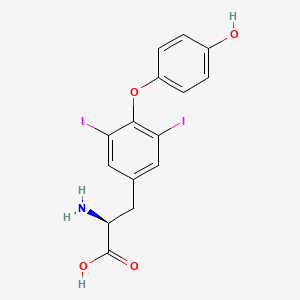
Hangzhou Leap Chem Co., Ltd. is one of the most professional manufacturers and suppliers of 3,5-diiodo-l-thyronine丨cas 1041-01-6 in China. Welcome to wholesale bulk high quality chemical products at competitive price from our factory. If you have any enquiry about custom service, please feel free to email us.
Specifications
|
Appearance: |
An odorless almost white or buff colored powder |
|
Assay (HPLC Analytical on the anhydrous basis): |
97%min |
|
Identification: |
The IR spectrum conforms with that of RS |
|
Specific rotation: |
+26° to +30° |
|
Loss on drying: |
4.0%max |
|
Residue on ignition: |
0.2%max |
|
Heavy metals: |
10ppm max |
|
Sulphate: |
0.05%max |
|
Arsenic: |
1ppm max |
Overview
3,5-Diiodo-L-thyronine丨CAS 1041-01-6 is a naturally occurring endogenous thyroid hormone metabolite. It arises from the deiodination of triiodothyronine (T3) and has garnered significant interest for its non-genomic metabolic effects, particularly in regulating energy metabolism and fat oxidation.
Applications
1. Biomedical and Endocrine Research
Thyroid Hormone Physiology Studies:
T2 is studied to understand the non-genomic actions of thyroid hormones, as it exerts biological activity independent of nuclear thyroid hormone receptors (TRs).
Mitochondrial Function Analysis:
It enhances mitochondrial respiration and oxidative phosphorylation, making it a valuable tool for investigating mitochondrial bioenergetics and dysfunction.
2. Metabolic and Obesity Research
Anti-Obesity Agent (Experimental):
T2 has shown potential to increase basal metabolic rate (BMR) and stimulate lipid oxidation without the severe side effects associated with T3 or T4 therapy.
Liver Fat Reduction:
In animal models, T2 administration led to reduced hepatic steatosis (fatty liver), suggesting potential in non-alcoholic fatty liver disease (NAFLD) research.
Thermogenesis Activation:
It may upregulate uncoupling proteins (UCPs) in brown adipose tissue, enhancing thermogenic energy expenditure.
3. Cardiovascular Research
Cardiometabolic Protection:
T2 has been reported to improve cardiac function and reduce cholesterol and triglyceride levels in preclinical studies, highlighting its role in metabolic syndrome and atherosclerosis research.
4. Diagnostic and Analytical Uses
Reference Compound in Assays:
T2 is used as a standard or reference in analytical methods for thyroid hormone metabolites in biological samples (e.g., LC-MS/MS assays).
Biomarker Studies:
It is investigated as a potential biomarker for thyroid activity or dysregulation in certain endocrine disorders.
Benefits
1. Mitochondrial Stimulation and Energy Expenditure
Rapidly increases oxygen consumption and ATP turnover, especially in liver and skeletal muscle.
Enhances fatty acid oxidation, making it effective in reducing lipid accumulation.
2. Low Risk of Thyrotoxicity
Compared to T3 or T4, T2 shows minimal impact on heart rate, muscle catabolism, and bone density, which are common concerns in hyperthyroidism.
3. Targeted Metabolic Effects
Acts selectively on metabolic pathways without widespread hormonal activation.
Potential to correct dyslipidemia and insulin resistance with fewer systemic side effects.
4. Research Relevance
Offers a valuable model for hormone metabolism, deiodinase activity, and non-genomic hormone actions in both humans and animals.
Conclusion
3,5-Diiodo-L-thyronine丨CAS 1041-01-6 is an important thyroid hormone metabolite with distinct and selective roles in regulating energy metabolism, fat oxidation, and mitochondrial activity. Its unique profile makes it a compelling candidate for experimental therapies in obesity, fatty liver disease, and metabolic disorders. While still under investigation, its low toxicity and targeted action continue to attract significant interest in biomedical and endocrine research.