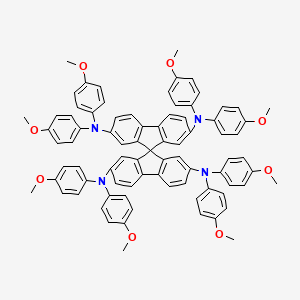
Hangzhou Leap Chem Co., Ltd. is one of the most professional manufacturers and suppliers of spiro meotad丨cas 207739-72-8 in China. Welcome to wholesale bulk high quality chemical products at competitive price from our factory. If you have any enquiry about custom service, please feel free to email us.
Specifications
|
Appearance |
Off white powder to solid |
|
Purity (HPLC) |
99.5% min |
|
HNMR |
Conforms |
Introduction
Spiro MeOTAD丨CAS 207739-72-8 (short for 2,2′,7,7′-Tetrakis(N,N-di-p-methoxyphenylamine)-9,9′-spirobifluorene), is a widely used organic compound in the field of optoelectronics, particularly in perovskite and dye-sensitized solar cells (DSSCs). It is primarily employed as a hole transport material (HTM) due to its excellent semiconducting properties and compatibility with various photoactive layers. Spiro-MeOTAD has become the benchmark HTM in the photovoltaic community, particularly for perovskite solar cell (PSC) development.
Applications of Spiro-MeOTAD
A. Perovskite Solar Cells (PSCs)
The most dominant application of Spiro-MeOTAD is as the hole-transport layer (HTL) in perovskite solar cells:
Interface Layer: It is deposited between the perovskite absorber layer and the metal electrode (usually gold or silver), facilitating hole extraction and transport.
Energy Level Matching: The HOMO level (~−5.2 eV) of Spiro-MeOTAD aligns well with the valence band of common perovskites like MAPbI₃, enabling efficient hole transfer.
Performance Enhancement: PSCs using Spiro-MeOTAD as HTM have achieved power conversion efficiencies (PCEs) exceeding 25%.
B. Dye-Sensitized Solar Cells (DSSCs)
Spiro-MeOTAD is also used as a solid-state HTM in DSSCs, replacing liquid electrolytes:
Improved Stability: Solid-state DSSCs with Spiro-MeOTAD offer greater stability over traditional liquid electrolyte-based devices.
Simplified Design: Its use enables the fabrication of more compact, leak-free, and durable solar modules.
C. Light-Emitting Diodes (LEDs)
While less common than in solar cells, Spiro-MeOTAD can also serve as an HTM in OLEDs:
Charge Transport: It assists in transporting holes from the anode to the emissive layer, improving device efficiency.
Thermal Stability: Its high glass transition temperature ensures morphological stability during operation.
D. Organic Photodetectors and Transistors
Emerging research also explores Spiro-MeOTAD in organic photodetectors and thin-film transistors (TFTs):
High Mobility: It can facilitate hole transport in low-voltage transistor applications.
Signal Amplification: In photodetectors, it aids in collecting photo-generated holes with minimal recombination.
Benefits of Spiro-MeOTAD
A. Efficient Hole Transport
Spiro MeOTAD丨CAS 207739-72-8 is engineered for efficient extraction and transport of holes, which is essential in improving the open-circuit voltage (V_oc) and overall efficiency of solar cells:
High Hole Mobility: Though relatively moderate in its pristine state, its mobility improves significantly with additives and doping.
Selective Transport: It transports holes efficiently while blocking electron transport, minimizing recombination losses at interfaces.
B. Compatibility with Doping and Additives
To enhance its performance, Spiro-MeOTAD is often doped with additives such as:
Lithium bis(trifluoromethanesulfonyl)imide (Li-TFSI) – increases hole concentration.
4-tert-butylpyridine (tBP) – modifies morphology and suppresses crystallization.
Cobalt-based dopants (e.g., FK209) – further improves hole mobility and conductivity.
This doping capability allows tuning of electrical properties, making Spiro-MeOTAD adaptable for various device architectures.
C. Excellent Film Formation and Processability
Spiro-MeOTAD is soluble in common organic solvents such as chlorobenzene and toluene, allowing solution processing techniques such as spin coating or blade coating:
Uniform Film Formation: It forms smooth, pinhole-free films essential for high-efficiency devices.
Scalability: Suitable for lab-scale and pilot-scale production of photovoltaic modules.
D. High Thermal and Morphological Stability
The spiro-linked bifluorene core gives the molecule a rigid, three-dimensional structure, which contributes to:
High Glass Transition Temperature (Tg ~125°C) – ensuring stability during device operation.
Resistance to Phase Separation – reducing degradation due to environmental stress.
This makes Spiro-MeOTAD reliable for long-term device operation under varied temperature conditions.
E. Optoelectronic Advantages
Transparency in Visible Spectrum: It does not absorb significantly in the visible range, ensuring that light reaches the active perovskite layer without losses.
Wide Bandgap (~3.0 eV): Prevents unwanted absorption while enabling high V_oc in devices.
Limitations and Considerations
Despite its advantages, Spiro-MeOTAD also presents some challenges:
Hygroscopic Doping Agents: Additives like Li-TFSI can absorb moisture, reducing device lifetime unless proper encapsulation is used.
High Cost: Spiro-MeOTAD is relatively expensive and complex to synthesize, limiting its use in large-scale commercial production.
Intrinsic Conductivity: The material has low intrinsic conductivity, necessitating the use of dopants for optimal performance.
These limitations have spurred the development of alternative HTMs (e.g., PTAA, P3HT, inorganic HTMs like CuSCN), though Spiro-MeOTAD remains the benchmark for research purposes.
Conclusion
Spiro MeOTAD丨CAS 207739-72-8 is a highly effective and widely used hole transport material in perovskite solar cells, dye-sensitized solar cells, and emerging optoelectronic applications. Its advantages include high hole mobility, processability, thermal stability, and compatibility with perovskite materials. Although cost and moisture sensitivity remain challenges, its unmatched performance makes it a cornerstone in cutting-edge solar cell research and development.