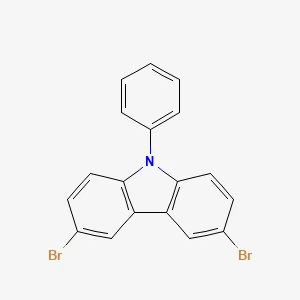
Hangzhou Leap Chem Co., Ltd. is one of the most professional manufacturers and suppliers of 9-vinylcarbazole丨cas 1484-13-5 in China. Welcome to wholesale bulk high quality chemical products at competitive price from our factory. If you have any enquiry about custom service, please feel free to email us.
Specifications of 9-Vinylcarbazole丨CAS 1484-13-5
|
Property |
Specification |
|
Appearance |
Off white to white solid |
|
Assay (GC) |
99% min |
|
Identification |
Rt = Rt standard |
|
Clarity in acetone (1 g product in 4 g acetone) |
Clarity |
Transport Information of 9-Vinylcarbazole丨CAS 1484-13-5
|
Parameter |
Specification |
|
UN Number |
2811 |
|
Class |
6 |
|
Packing Group |
II |
|
H.S. Code |
2933990099306 |
|
Stability & Reactivity |
Stable |
|
Storage |
Store in a closed, dry, ventilated place, locked |
|
Condition to Avoid |
Strong acid, strong oxidant agents |
|
Package |
Introduction of 9-Vinylcarbazole丨CAS 1484-13-5
9-Vinylcarbazole丨CAS 1484-13-5 is an organic compound that has gained significant attention for its applications in polymer chemistry, organic electronics, and optoelectronic devices. The compound is characterized by the presence of a vinyl group attached to the nitrogen atom of the carbazole ring, which allows it to polymerize and form various functional materials. Here are the primary applications and benefits of 9-vinylcarbazole:
Applications of 9-Vinylcarbazole丨CAS 1484-13-5
1. Polymer Synthesis:
- Poly(N-vinylcarbazole) (PVK): The most notable application of 9-vinylcarbazole is in the production of poly(N-vinylcarbazole) (PVK), a conducting polymer that is widely used in electronic and optoelectronic applications. PVK is synthesized through the polymerization of 9-vinylcarbazole and exhibits unique properties such as high photoconductivity and charge transport capabilities.
- Copolymer Synthesis: 9-Vinylcarbazole is also used as a monomer in the synthesis of copolymers, where it is combined with other monomers to create materials with tailored electronic, optical, and mechanical properties. These copolymers find applications in advanced materials and coatings.
2. Organic Electronics:
- Electroluminescent Devices: PVK and its derivatives are used in the fabrication of organic light-emitting diodes (OLEDs). The high photoconductivity and charge transport properties of PVK make it an excellent hole transport layer (HTL) in OLED devices, improving their efficiency and performance.
- Photorefractive Materials: 9-Vinylcarbazole-based polymers are used in the development of photorefractive materials, which are important in holography, 3D displays, and optical data storage. These materials can change their refractive index in response to light, enabling dynamic image recording and processing.
- Organic Photovoltaics (OPVs): In organic solar cells, 9-Vinylcarbazole丨CAS 1484-13-5 and its derivatives are used as components of the active layer, where they contribute to efficient light absorption and charge transport, enhancing the power conversion efficiency of the solar cells.
3. Optoelectronic Devices:
- Photoconductors: 9-Vinylcarbazole-based materials are employed as photoconductors in various optoelectronic devices, including photocopiers, laser printers, and photodetectors. These materials are sensitive to light and can generate electrical signals in response to optical input.
- Nonlinear Optical Materials: The compound is also used in the synthesis of nonlinear optical materials, which are essential in the development of optical communication systems, frequency converters, and other photonic devices.
4. Charge-Transport Materials:
- Hole Transport Layers (HTL): In addition to its use in OLEDs, 9-vinylcarbazole is a key material in the development of hole transport layers for various optoelectronic devices. These layers facilitate the movement of positive charges (holes) within the device, improving overall efficiency and performance.
5. Photovoltaic Research:
- Organic Solar Cells: In research focused on improving the efficiency of organic solar cells, 9-vinylcarbazole is used to develop new active materials that enhance the absorption of light and the generation of charge carriers, contributing to higher power conversion efficiencies.
Benefits of 9-Vinylcarbazole丨CAS 1484-13-5
1. High Photoconductivity:
- Efficient Charge Transport: 9-Vinylcarbazole and its polymers, particularly PVK, exhibit high photoconductivity, making them ideal for applications that require efficient charge transport, such as OLEDs, photorefractive materials, and photoconductors.
2. Versatility in Polymerization:
- Flexible Synthesis: The vinyl group in 9-vinylcarbazole allows it to undergo polymerization easily, leading to the formation of homopolymers and copolymers with a wide range of properties. This versatility makes it a valuable monomer in polymer chemistry and materials science.
3. Stability and Durability:
- Thermal and Chemical Stability: Polymers derived from 9-vinylcarbazole, like PVK, are known for their thermal and chemical stability. This durability is crucial for the longevity of electronic devices and materials, particularly those exposed to harsh operating conditions.
4. Tunable Optoelectronic Properties:
- Customizable Performance: The optoelectronic properties of materials based on 9-Vinylcarbazole丨CAS 1484-13-5 can be tuned by modifying the polymer structure or by copolymerizing with other monomers. This ability to customize material properties is beneficial in optimizing the performance of optoelectronic devices.
5. Improved Device Performance:
- Enhanced Efficiency: In OLEDs and other organic electronic devices, the use of 9-vinylcarbazole in the hole transport layer contributes to improved device efficiency by facilitating charge injection and transport, leading to brighter displays and more efficient lighting.
6. Photorefractive Capabilities:
- Advanced Imaging and Storage: The photorefractive properties of 9-vinylcarbazole-based materials enable the development of advanced imaging systems, holographic displays, and optical data storage devices that require materials capable of dynamic refractive index changes.
Precautions and Considerations:
1. Handling and Safety:
- Toxicity and Irritation: As with many organic compounds, 9-Vinylcarbazole丨CAS 1484-13-5 should be handled with appropriate safety measures to avoid exposure. It may be irritating to the skin, eyes, and respiratory system, so personal protective equipment (PPE) should be used.
2. Polymerization Control:
- Polymerization Conditions: The polymerization of 9-vinylcarbazole needs to be carefully controlled to achieve the desired polymer properties. Factors such as temperature, initiator concentration, and reaction time must be optimized for each application.
3. Environmental Considerations:
- Waste Disposal: Proper disposal of waste materials containing 9-vinylcarbazole is important to minimize environmental impact. Waste should be treated and disposed of according to local regulations and guidelines.
Conclusion:
9-Vinylcarbazole丨CAS 1484-13-5 is a highly valuable compound in the fields of polymer chemistry, organic electronics, and optoelectronics. Its ability to polymerize and form materials with high photoconductivity, thermal stability, and customizable properties makes it essential for applications such as OLEDs, photorefractive materials, and organic solar cells. The benefits of 9-vinylcarbazole include its versatility in synthesis, contribution to improved device performance, and potential for advanced imaging and optical storage applications. Proper handling, polymerization control, and environmental considerations are important to ensure its safe and effective use.