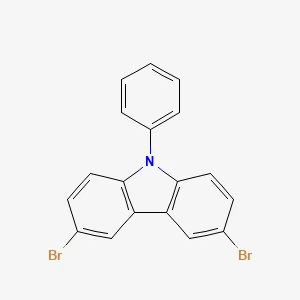
Hangzhou Leap Chem Co., Ltd. is one of the most professional manufacturers and suppliers of n-(3-bromophenyl)carbazole丨cas 185112-61-2 in China. Welcome to wholesale bulk high quality chemical products at competitive price from our factory. If you have any enquiry about custom service, please feel free to email us.
Specifications of N-(3-Bromophenyl)carbazole | CAS 185112-61-2
|
Parameter |
Specification |
|
Appearance |
Off White powder |
|
Purity |
99%min |
Introduction of N-(3-Bromophenyl)carbazole | CAS 185112-61-2
N-(3-Bromophenyl)carbazole | CAS 185112-61-2 is an advanced organic compound utilized in the field of organic synthesis and materials science. Known for its distinctive chemical properties, this compound is a valuable building block in the development of materials for electronic and optoelectronic applications.
Applications of N-(3-Bromophenyl)carbazole | CAS 185112-61-2
1.Organic Electronics and Optoelectronics:
- OLEDs and Light-Emitting Applications: N-(3-Bromophenyl)carbazole plays a pivotal role in the synthesis of materials for organic light-emitting diodes (OLEDs), contributing to enhanced luminescence efficiency and device lifespan.
- Semiconducting Polymers: This compound is integral in the creation of semiconducting polymers, which are widely used in optoelectronic devices such as organic field-effect transistors (OFETs) and organic photovoltaics (OPVs).
2.Polymer Chemistry:
- Monomer in Polymer Development: As a monomer, N-(3-Bromophenyl)carbazole enables the synthesis of high-performance polymers with fine-tuned electronic and optical properties.
- Copolymer Applications: It is employed in the production of copolymers that exhibit improved processability and stability, essential for high-end optoelectronic systems.
3.Materials Science and Photonics:
- Advanced Electronic Materials: N-(3-Bromophenyl)carbazole | CAS 185112-61-2 is utilized in designing materials with excellent charge transport and photophysical properties, critical for devices like photodetectors and sensors.
- Photoconductive Applications: Its derivatives are employed in creating photoconductive materials with high sensitivity, suitable for imaging technologies.
4.Thin-Film Transistors (OTFTs):
- This compound is instrumental in the development of OTFTs used in flexible displays, wearable technology, and other innovative electronics requiring lightweight and flexible materials.
Benefits of N-(3-Bromophenyl)carbazole | CAS 185112-61-2
1.Versatility in Synthesis:
- Its structure allows for easy functionalization, making it a flexible intermediate in creating complex polymers and materials tailored for specific applications.
2.Enhanced Electronic and Optical Properties:
- Materials synthesized from N-(3-Bromophenyl)carbazole | CAS 185112-61-2 exhibit superior charge transport, photoluminescence, and thermal stability, ensuring reliable device performance.
3.Stability and Longevity:
- The compound contributes to the development of materials with exceptional thermal and chemical stability, crucial for durable electronic devices.
4.Tunable Properties:
- By incorporating N-(3-Bromophenyl)carbazole, researchers can precisely control material properties like bandgap and light absorption, optimizing performance for OLEDs, solar cells, and more.
5.Support for Emerging Technologies:
- It is a foundational material in the pursuit of next-generation technologies, including flexible electronics, organic solar panels, and high-efficiency light sources.
Precautions and Considerations of Using N-(3-Bromophenyl)carbazole | CAS 185112-61-2
1.Handling and Safety:
- N-(3-Bromophenyl)carbazole should be handled with care in a controlled environment. Use personal protective equipment (PPE) to minimize exposure risks.
2.Environmental Responsibility:
- Proper disposal of the compound and its derivatives is essential to reduce environmental impact. Follow local regulations for chemical waste management.
3.Sourcing and Cost:
- The compound is commercially available in various grades. Manufacturers and researchers should consider the cost and purity specifications to ensure suitability for their intended applications.
Conclusion:
N-(3-Bromophenyl)carbazole | CAS 185112-61-2 is an indispensable component in the realm of organic electronics and advanced material synthesis. Its role in enhancing electronic, optical, and thermal properties of materials ensures its relevance in the development of cutting-edge technologies. With proper handling and a focus on sustainability, it promises to drive innovation in applications ranging from OLEDs to molecular electronics.