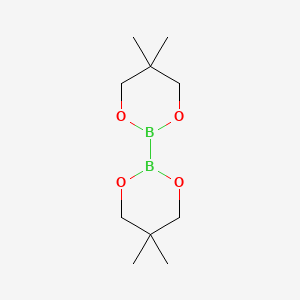
Hangzhou Leap Chem Co., Ltd. is one of the most professional manufacturers and suppliers of bis(neopentyl glycolato)diboron丨cas 201733-56-4 in China. Welcome to wholesale bulk high quality chemical products at competitive price from our factory. If you have any enquiry about custom service, please feel free to email us.
Custom Synthesis Bis(neopentyl glycolato)diboron丨CAS 201733-56-4
Chemical Identifiers
| InChI | 1S/C10H20B2O4/c1-9(2)5-13-11(14-6-9)12-15-7-10(3,4)8-16-12/h5-8H2,1-4H3 |
| InChI Key | MDNDJMCSXOXBFZ-UHFFFAOYSA-N |
| Smiles | CC1(C)COB(B2OCC(C)(C)CO2)OC1 |
| EC No. | 639-407-9 |
| MDL No. | MFCD02093062 |
| PubChem CID | 2734316 |
Applications
Applications in Suzuki–Miyaura Cross-Coupling Reactions
Bis(neopentyl glycolato)diboron plays an indirect but important role in Suzuki–Miyaura cross-coupling chemistry by enabling the preparation of organoboron coupling partners. Boronate esters synthesized using this reagent can react with compatible organic halides or pseudohalides under suitable catalytic conditions to form carbon–carbon bonds. This two-stage strategy allows chemists to convert an aryl halide into a boronate ester and subsequently incorporate that fragment into a larger molecular structure. It is particularly useful for constructing substituted biaryls and heteroaromatic compounds.
Applications in Medicinal Chemistry
In medicinal chemistry, Bis(neopentyl glycolato)diboron supports the preparation of structurally diverse organic intermediates. Borylation reactions enable researchers to introduce boron functionality at selected positions of aromatic and heteroaromatic molecules, creating versatile intermediates for further coupling reactions. This approach can facilitate the synthesis of analog libraries and the modification of lead compounds. The resulting molecules may be investigated for biological activity, physicochemical properties, and structure–activity relationships.
Applications in Pharmaceutical Intermediate Synthesis
Bis(neopentyl glycolato)diboron is relevant to pharmaceutical intermediate synthesis involving multistep carbon–carbon bond construction. Through suitable borylation reactions, it enables the conversion of selected organic substrates into protected boronate esters. These intermediates can subsequently participate in cross-coupling reactions to introduce aromatic or heteroaromatic fragments into complex molecular frameworks. The reagent provides an additional option for route development when boronate ester structure, substrate compatibility, or downstream reaction performance requires optimization.
Applications in C–H Borylation Research
Bis(neopentyl glycolato)diboron may also be investigated in transition-metal-catalyzed C–H borylation reactions. Under appropriately developed catalytic conditions, diboron reagents can introduce boron functionality directly into selected carbon–hydrogen bonds, reducing the need for prefunctionalized substrates. This strategy is valuable for preparing organoboron intermediates and exploring site-selective aromatic functionalization. Reaction feasibility, regioselectivity, and efficiency depend on the catalyst system, substrate structure, and operating conditions.