

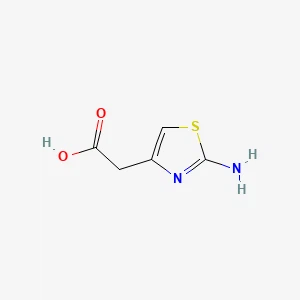
Hangzhou Leap Chem Co., Ltd. is one of the most professional manufacturers and suppliers of 2-aminothiazol-4-acetic acid丨cas 29676-71-9 in China. Welcome to wholesale bulk high quality chemical products at competitive price from our factory. If you have any enquiry about custom service, please feel free to email us.
Specifications
| Appearance | White or off white powder |
| Assay (on dried basis) | 99% min |
| Identification | Conforms |
| Water | 0.3% max |
| Melting point | 129°C min |
| Individual impurity | 1% max |
| Total impurities | 1.5% max |
Transport Information
|
Parameter |
Specification |
|
UN Number |
|
|
Class |
|
|
Packing Group |
|
|
H.S. Code |
2934999099305 |
|
Stability & Reactivity |
The product is chemically stable under standard ambient conditions. |
|
Storage |
Keep container tightly closed. Store in a refrigerator. |
|
Condition to Avoid |
Heat. Exposure to air |
|
Package |
Manufacturing Information
|
Parameter |
Specification |
|
Capacity |
10MT/month |
|
Frequency |
|
|
Main Export Countries |
|
|
Capacity/Batch |
|
|
Experience |
Production since 1993 |
|
Stock |
Applications
2-Aminothiazol-4-acetic acid (CAS 29676-71-9) is a heterocyclic amino acid derivative widely used as an intermediate in pharmaceutical and agrochemical synthesis. Its 2-aminothiazole core with an acetic acid side chain makes it a versatile building block for the design of β-lactam antibiotics, enzyme inhibitors, and other bioactive compounds. In medicinal chemistry, it is applied in the synthesis of penicillin and cephalosporin analogues, where the aminothiazole ring enhances antibacterial activity and binding specificity. In agrochemicals, it serves as a precursor for herbicides, fungicides, and insecticides with improved efficacy. Additionally, it is used in organic synthesis to create functionalized heterocycles and study structure–activity relationships in drug development.
Benefits
The benefits of 2-aminothiazol-4-acetic acid arise from its multifunctional reactivity and biologically relevant scaffold. The amino group allows selective derivatization, coupling, and condensation reactions, while the acetic acid moiety provides solubility and enables further functionalization. The aminothiazole ring contributes electronic and steric features that enhance binding affinity in biological targets. Its combination of reactivity, stability, and biological relevance makes it a highly adaptable intermediate for the efficient synthesis of antibiotics, agrochemicals, and other bioactive molecules.
Conclusion
In summary, 2-aminothiazol-4-acetic acid is a valuable heterocyclic intermediate in pharmaceutical and agrochemical synthesis. Its applications include the preparation of β-lactam antibiotics, enzyme inhibitors, and crop-protection agents, while its benefits lie in multifunctional reactivity, scaffold stability, and biological relevance. As demand for effective heterocyclic intermediates continues to grow, this compound remains a critical tool for designing and synthesizing bioactive molecules.


