

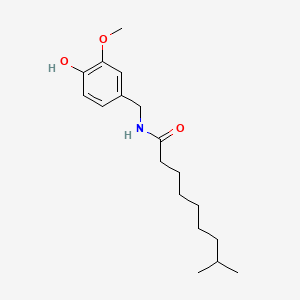
Hangzhou Leap Chem Co., Ltd. is one of the most professional manufacturers and suppliers of dihydrocapsaicin丨cas 19408-84-5 in China. Welcome to wholesale bulk high quality chemical products at competitive price from our factory. If you have any enquiry about custom service, please feel free to email us.
Specifications
|
Appearance: |
White solid, soluble in ethyl acetate, methanol |
|
Purity (HPLC): |
98% min |
|
Control identification: |
The chromatographic peak time was consistent with that of the control product |
Transport Information
|
Parameter |
Specification |
|
UN Number |
3462 |
|
Class |
6 |
|
Packing Group |
|
|
H.S. Code |
3302109090302 |
|
Stability & Reactivity |
The product is chemically stable under standard ambient conditions. |
|
Storage |
Keep container tightly closed in a dry and well-ventilated place. Recommended storage temperature 2 - 8 °C |
|
Condition to Avoid |
|
|
Package |
Dihydrocapsaicin丨CAS 19408-84-5 is one of the major pungent components of chili peppers, closely related to capsaicin. It accounts for about 22–35% of the total capsaicinoid content in chili peppers. Like capsaicin, dihydrocapsaicin activates TRPV1 receptors (transient receptor potential vanilloid type-1) in sensory neurons, producing the characteristic burning sensation. Its structure is similar to capsaicin but with a saturated side chain (i.e., no double bond), making it slightly more thermally stable.
Applications
1. Pharmaceutical and Biomedical Research
Pain research: Used as a TRPV1 agonist to study pain perception and desensitization of sensory neurons.
Neurobiology: Dihydrocapsaicin helps researchers understand the mechanism of nociception and neurogenic inflammation.
Analgesic development: Investigated for topical application in treating:
Neuropathic pain
Rheumatoid arthritis
Diabetic neuropathy
2. Cancer Research
Studies suggest capsaicinoids like dihydrocapsaicin may:
Induce apoptosis in certain cancer cell lines.
Inhibit cancer cell proliferation and angiogenesis.
Enhance the effect of chemotherapeutic agents.
3. Metabolic and Cardiovascular Research
Known to influence thermogenesis, fat oxidation, and energy expenditure.
May be useful in the study of:
Obesity and metabolic syndrome
Hypertension
Vascular function and oxidative stress
4. Food Industry (Research & Analysis)
Used as a standard compound in HPLC and GC-MS methods for quantifying capsaicinoid content in chili-derived food products.
Plays a role in sensory evaluation studies and pungency scale calibration.
5. Agricultural and Pest Deterrents
Like other capsaicinoids, can be used in natural repellents for mammals and insects.
Shows promise as an eco-friendly pest control agent when formulated appropriately.
Key Benefits and Characteristics
Stable structure: More stable than capsaicin due to absence of alkene in the side chain.
TRPV1 specificity: Powerful activator used in receptor-targeted screening and validation.
Natural origin: Extracted from chili peppers or synthesized analogously.
Potent bioactivity: Strong pungency and biological effect at low concentrations.
Summary
Dihydrocapsaicin丨CAS 19408-84-5 is a naturally occurring capsaicinoid with strong TRPV1 receptor agonist activity, used widely in pain research, cancer studies, and metabolic regulation experiments. It is also a reference standard in the food industry and serves as a basis for developing topical analgesics and biological repellents. Its stable, saturated structure offers certain advantages over capsaicin in formulation and analytical chemistry.


