Technical Parameters
Description
Hangzhou Leap Chem Co., Ltd. is one of the most professional manufacturers and suppliers of chloramphenicol-d5丨cas 202480-68-0 in China. Welcome to wholesale bulk high quality chemical products at competitive price from our factory. If you have any enquiry about custom service, please feel free to email us.
Professional Supplier Chloramphenicol-d5丨CAS 202480-68-0
Chemical Identifiers
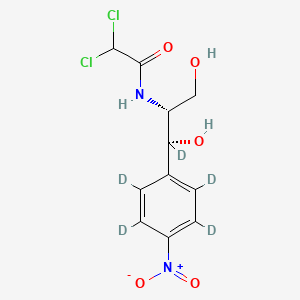
| InChI | InChI=1S/C11H12Cl2N2O5/c12-10(13)11(18)14-8(5-16)9(17)6-1-3-7(4-2-6)15(19)20/h1-4,8-10,16-17H,5H2,(H,14,18)/t8-,9-/m1/s1/i1D,2D,3D,4D,9D |
| InChI Key | WIIZWVCIJKGZOK-CJBPKKHQSA-N |
| Smiles | [2H]C1=C(C(=C(C(=C1[C@]([2H])([C@@H](CO)NC(=O)C(Cl)Cl)O)[2H])[2H])[N+](=O)[O-])[2H] |
| EC No. | 632-585-9 |
| MDL No. | MFCD18384950 |
| PubChem CID | 71312380 |
Applications
LC-MS/MS and Quantitative Analysis
Chloramphenicol-d5 can be used as an isotopically labeled internal standard in suitable liquid chromatography–tandem mass spectrometry (LC-MS/MS) methods. When validated for the target matrix and analytical conditions, it can help compensate for variations in sample preparation, instrument response, and matrix effects, supporting reliable chloramphenicol quantification.
Food Safety and Residue Analysis
Chloramphenicol residue monitoring is important in food safety testing, particularly for products of animal origin. Chloramphenicol-d5 can support the development, validation, and quality control of analytical methods used to detect and quantify chloramphenicol residues in suitable food matrices.
Pharmaceutical Analytical Research
In pharmaceutical analysis, isotopically labeled analogues can help researchers develop and validate quantitative methods for active compounds and related substances. Chloramphenicol-d5 may serve as a reference or internal-standard material in analytical workflows designed to measure chloramphenicol in pharmaceutical preparations and other appropriate samples.
Bioanalytical Method Development
Stable-isotope-labeled compounds are valuable in bioanalytical research because they can provide a distinguishable signal while often exhibiting similar analytical behavior to the target analyte. Chloramphenicol-d5 may support method development for measuring chloramphenicol in biological matrices, subject to validation of its performance, isotopic purity, and suitability for the specific assay.