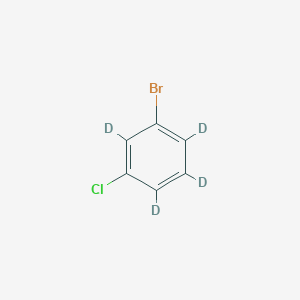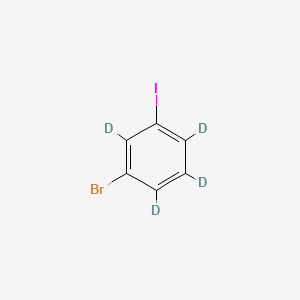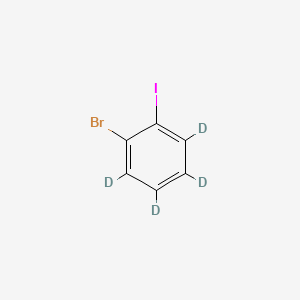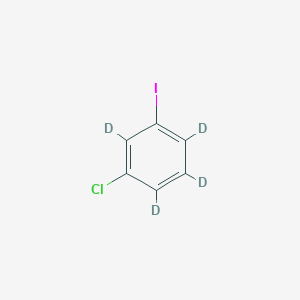
Technical Parameters
Description
Hangzhou Leap Chem Co., Ltd. is one of the most professional manufacturers and suppliers of 1-bromo-4-chlorobenzene-d4丨cas 13415-42-4 in China. Welcome to wholesale bulk high quality chemical products at competitive price from our factory. If you have any enquiry about custom service, please feel free to email us.
China Supplier 1-Bromo-4-chlorobenzene-d4丨CAS 13415-42-4
Chemical Identifiers
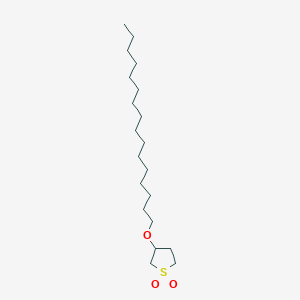
| InChI | InChI=1S/C20H40O3S/c1-2-3-4-5-6-7-8-9-10-11-12-13-14-15-17-23-20-16-18-24(21,22)19-20/h20H,2-19H2,1H3 |
| InChI Key | XKIKVSBMWXPRBQ-UHFFFAOYSA-N |
| Smiles | CCCCCCCCCCCCCCCCOC1CCS(=O)(=O)C1 |
| EC No. | |
| MDL No. | |
| PubChem CID | 3094477 |
Applications
Analytical Chemistry and Mass Spectrometry
Deuterated compounds are valuable tools in analytical method development and isotope-labeling studies. Depending on the target analyte and analytical workflow, 1-Bromo-4-chlorobenzene-d4 may be used in the preparation of labeled compounds or reference materials for investigating chemical behavior and analytical performance.
Pharmaceutical Research and Drug Discovery
1-Bromo-4-chlorobenzene-d4 can be used as an intermediate in the synthesis of deuterium-labeled aromatic compounds for pharmaceutical research. Isotopic labeling can help researchers investigate molecular metabolism, reaction pathways, and the behavior of labeled compounds during drug discovery and development.
Organic Synthesis and Chemical Research
The bromine and chlorine substituents provide different reactive sites for exploring selective functionalization and cross-coupling chemistry. Researchers can use this compound as a starting material for developing substituted aromatic structures and preparing specialized deuterated intermediates.
Materials Science and Advanced Materials
Deuterated aromatic intermediates can support the synthesis of specialized organic molecules investigated in advanced materials research. 1-Bromo-4-chlorobenzene-d4 may be incorporated into synthetic routes for functional aromatic compounds where both isotopic labeling and halogen substitution are relevant to the target structure.