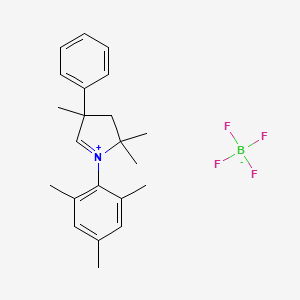
Hangzhou Leap Chem Co., Ltd. is one of the most professional manufacturers and suppliers of 1,3-dimesityl-4,5-dimethyl-1h-imidazol-3-ium chloride丨cas 1118916-80-5 in China. Welcome to wholesale custom made chemical products at competitive price from our factory. For more cheap products, contact us now.
Specifications
| Appearance | White Powder |
| Purity (NMR) | 95% Min |
Applications
1,3-Dimesityl-4,5-dimethyl-1H-imidazol-3-ium chloride is widely used as a precursor for generating N-heterocyclic carbenes (NHCs), particularly those that offer a balanced combination of steric bulk and strong σ-donating ability. Upon deprotonation, it forms a stable carbene that readily coordinates to metals such as Pd, Au, Ag, Ru, Ir, and Cu, producing efficient catalysts for cross-coupling reactions, hydrosilylation, allylation, olefin metathesis, and various C–C and C–X bond-forming processes. Its mesityl substituents and additional methyl groups on the imidazole ring increase steric hindrance and electron density, making the derived NHC an effective ligand for homogeneous catalysis in pharmaceutical synthesis, polymer chemistry, fine-chemical production, and materials-oriented transformations. The compound is also used in catalytic method development, mechanistic studies of NHC–metal interactions, and research programs focused on designing high-performance, air-stable, and thermally robust catalytic systems.
Benefits
The primary benefits of this compound stem from its steric and electronic properties, which are optimized for generating stable and reactive NHC ligands. The bulky mesityl groups protect metal centers from deactivation pathways, improving catalyst durability and resistance to aggregation or decomposition. The electron-rich carbene produced from this salt enhances metal-ligand bonding strength, often resulting in higher turnover numbers, better yields, and improved selectivity in complex reactions. The additional methyl groups on the ring fine-tune the electronic environment, enabling more precise control over catalytic behavior. The chloride counterion ensures good solubility and predictable reactivity during carbene generation, supporting consistent performance in laboratory and industrial settings. Overall, the material provides a dependable route to high-efficiency metal catalysts suitable for demanding synthetic applications.
Conclusion
1,3-Dimesityl-4,5-dimethyl-1H-imidazol-3-ium chloride serves as a valuable and versatile precursor for producing robust NHC ligands used in modern catalysis. Its steric shielding, strong electron-donating profile, and reliable handling characteristics make it a preferred building block for developing stable, selective, and high-performance metal–carbene catalytic systems. Through its broad applicability and excellent balance of properties, it supports efficient synthesis across pharmaceuticals, fine chemicals, and advanced materials.