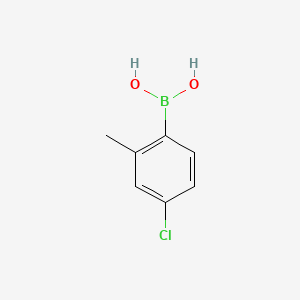
Hangzhou Leap Chem Co., Ltd. is one of the most professional manufacturers and suppliers of 4,4'-biphenyldiboronic acid丨cas 4151-80-8 in China. Welcome to wholesale bulk high quality chemical products at competitive price from our factory. If you have any enquiry about custom service, please feel free to email us.
Big Supplier 4,4'-Biphenyldiboronic Acid丨CAS 4151-80-8
Chemical Identifiers
| InChI | 1S/C12H12B2O4/c15-13(16)11-5-1-9(2-6-11)10-3-7-12(8-4-10)14(17)18/h1-8,15-18H |
| InChI Key | SLHKDOGTVUCXKX-UHFFFAOYSA-N |
| Smiles |
OB(C1=CC=C(C2=CC=C(B(O)O)C=C2)C=C1)O |
| EC No. | 670-287-0 |
| MDL No. | MFCD00151795 |
| PubChem CID | 2734608 |
Applications
Applications in Polymer Synthesis and Covalent Organic Frameworks
The bifunctional nature of 4,4'-Biphenyldiboronic acid makes it useful in the preparation of boron-containing polymers and porous materials. Its boronic acid groups can undergo condensation with suitable diols and polyols to form boronate ester linkages. This chemistry is particularly relevant to the synthesis of covalent organic frameworks (COFs), where appropriately designed building blocks assemble into ordered porous networks. The rigid biphenyl structure can contribute to framework geometry and aromatic character. These materials are investigated for gas storage, molecular separation, adsorption, catalysis, and other functional applications.
Applications in Organic Synthesis and Cross-Coupling Reactions
A major application of 4,4'-Biphenyldiboronic acid is palladium-catalyzed Suzuki–Miyaura cross-coupling. Both boronic acid groups can react with suitable aryl or heteroaryl halides, allowing the preparation of extended biaryl structures and multi-substituted aromatic compounds. Depending on the reaction design, sequential or double coupling can be used to introduce different aromatic fragments or construct symmetrical molecular architectures. The biphenyl core provides an extended structural unit that can help build larger conjugated systems for synthetic and materials chemistry.
Applications in Organic Electronics and Functional Materials
The extended biphenyl structure of this compound makes it a useful precursor for developing aromatic molecules and materials with tailored electronic and optical properties. Through cross-coupling reactions, it can be incorporated into larger conjugated structures investigated for organic electronic devices, optoelectronic materials, and luminescent compounds. The ability to introduce different aromatic substituents at both ends of the molecule provides flexibility in molecular design and the adjustment of conjugation length, structural rigidity, and intermolecular interactions.
Applications in Pharmaceutical and Fine Chemical Research
4,4'-Biphenyldiboronic acid can serve as a bifunctional building block for preparing symmetrical or extended aromatic intermediates. Its two reactive boronic acid groups allow the introduction of multiple aromatic fragments through suitable coupling reactions. This capability supports the synthesis of complex molecular scaffolds for medicinal chemistry research, compound library development, and specialty fine chemical synthesis. It is particularly relevant when a rigid, extended biphenyl unit is required in the target molecular structure.