

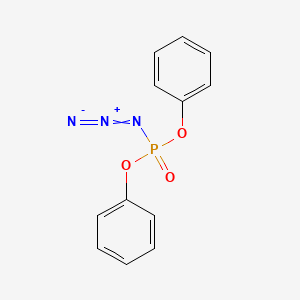
Hangzhou Leap Chem Co., Ltd. is one of the most professional manufacturers and suppliers of diphenylphosphoryl azide丨cas 26386-88-9 in China. Welcome to wholesale bulk high quality chemical products at competitive price from our factory. If you have any enquiry about custom service, please feel free to email us.
Specifications
| Appearance: | Colorless to light yellow liquid |
| Purity: | 98% min |
Transport Information
|
Parameter |
Specification |
|
UN Number |
3278 |
|
Class |
6 |
|
Packing Group |
II |
|
H.S. Code |
2929909090 |
|
Stability & Reactivity |
The product is chemically stable under standard ambient conditions. |
|
Storage |
Tightly closed. Store in a closed, dry, ventilated place |
|
Condition to Avoid |
|
|
Package |
Manufacturing Information
|
Parameter |
Specification |
|
Capacity |
1,500MT/year |
|
Frequency |
|
|
Main Export Countries |
|
|
Capacity/Batch |
|
|
Experience |
Production since 2001 |
|
Stock |
Applications
1. Curtius Rearrangement
DPPA is commonly used to convert carboxylic acids into isocyanates via Curtius rearrangement, particularly when milder conditions are required compared to acyl azide preparation with hydrazoic acid.
The isocyanates generated can be trapped with alcohols, amines, or water to give urethanes, ureas, or carbamates.
2. Peptide Synthesis / Amide Bond Formation
Efficient for amide bond formation from carboxylic acids and amines.
Serves as a coupling agent, activating the acid without the need for conventional peptide coupling reagents like DCC or EDC.
3. Synthesis of Heterocycles
Useful in the formation of triazoles, tetrazoles, and other N-containing heterocycles through azide-related cycloaddition reactions.
4. Click Chemistry / Azide Reagent
Acts as an azide donor in reactions involving azide-alkyne cycloaddition, a popular bioorthogonal reaction in chemical biology and materials science.
5. Preparation of Ureas and Carbamates
Through Curtius-type rearrangement, DPPA helps in converting carboxylic acids to urea derivatives by isocyanate intermediates-valuable in pharmaceutical intermediate synthesis.
Benefits
✅ Versatile Reagent
Offers a clean and efficient route to generate azide intermediates and isocyanates, key in multiple synthetic pathways.
✅ Mild Reaction Conditions
Allows transformations under relatively mild temperatures and solvent conditions, reducing degradation of sensitive substrates.
✅ High Functional Group Tolerance
Can be used with a wide variety of functional groups, enabling application in complex molecule synthesis.
✅ Useful in Green Chemistry
When properly controlled, DPPA-based Curtius rearrangements avoid using toxic hydrazoic acid and offer atom-efficient routes to nitrogen-containing products.
Conclusion
Diphenylphosphoryl azide (DPPA) is a powerful synthetic tool in organic chemistry, offering efficient routes to amides, ureas, carbamates, and isocyanates via mild Curtius rearrangements and azide chemistry. Its broad applications in pharmaceutical synthesis, peptide chemistry, and heterocyclic compound construction make it a highly valuable reagent, though proper handling and storage are essential due to its reactive azide functionality.


