

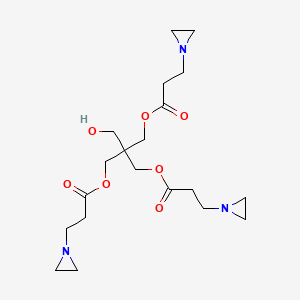
Hangzhou Leap Chem Co., Ltd. is one of the most professional manufacturers and suppliers of pentaerythritol tris3-(1-aziridinyl)propionate丨cas 57116-45-7 in China. Welcome to wholesale bulk high quality chemical products at competitive price from our factory. If you have any enquiry about custom service, please feel free to email us.
Specifications of Pentaerythritol tris3-(1-aziridinyl)propionate丨57116-45-7
|
Property |
Specification |
|
Appearance |
Colorless to light yellow liquid |
|
Purity |
98% min |
|
Viscosity (cp @ 25℃) |
4000 max |
|
Aziridine content |
6.74 mol/Kg |
|
Hydroxy content |
2.34 mol/Kg |
|
Density (g/ml @ 20℃) |
1.18 - 1.20 |
|
Freezing Point |
-10°C |
|
Flash Point |
100°C min |
|
Solubility |
Soluble in water and common organic solvents |
Introduction
Pentaerythritol tris3-(1-aziridinyl)propionate丨57116-45-7 is a chemical compound that belongs to the class of aziridine-functionalized pentaerythritols. Pentaerythritol is a polyalcohol that can react with various functional groups, including aziridine rings, to form compounds with unique properties. The presence of the aziridine group (a three-membered nitrogen-containing ring) gives this compound distinctive reactivity, especially in the context of polymer chemistry and crosslinking reactions.
Aziridine derivatives like Pentaerythritol tris3-(1-aziridinyl)propionate丨57116-45-7 are utilized in specialized applications, including adhesives, coatings, and pharmaceutical formulations. The aziridine group is known for its ability to participate in crosslinking reactions and chemical bonding, making these compounds valuable in the production of materials that require enhanced durability and chemical resistance.
Applications of Pentaerythritol tris3-(1-aziridinyl)propionate丨57116-45-7
1. Crosslinking Agent for Polymers
One of the primary uses of Pentaerythritol tris3-(1-aziridinyl)propionate丨57116-45-7 is as a crosslinking agent in polymer systems. The aziridine groups on this compound react with functional groups on other polymer molecules, such as hydroxyl or amine groups, to form covalent bonds and create a network structure. This crosslinking process improves the mechanical properties of the polymer, such as strength, flexibility, and chemical resistance.
● Polymer Coatings: This compound can be used to modify the properties of coatings and paint formulations. By crosslinking with the polymer matrix, it enhances the adhesion of the coating to surfaces and improves its durability and resistance to environmental conditions such as heat, moisture, and chemicals.
2. Adhesive Formulations
The crosslinking potential of pentaerythritol tris(3-(1-aziridinyl)propionate) makes it a valuable ingredient in adhesive formulations. The aziridine groups can react with the substrates to form strong, durable bonds, enhancing the performance of the adhesive. This is particularly useful in applications where high bonding strength is required, such as in the automotive, electronics, and construction industries.
● High-Performance Adhesives: Its incorporation into adhesive formulations allows for the creation of high-strength, heat-resistant adhesives capable of bonding difficult materials, such as metals, plastics, and composite materials.
3. Pharmaceuticals and Drug Delivery
In the pharmaceutical industry, Pentaerythritol tris3-(1-aziridinyl)propionate丨57116-45-7 may have potential applications in the area of drug delivery systems. The aziridine group is known to interact with biological molecules such as proteins, enzymes, and nucleic acids. This interaction could be used to design targeted drug delivery systems where the compound acts as a biocompatible linker or carrier for pharmaceuticals.
● Drug Release Systems: The compound may also be used in controlled release formulations, where the crosslinking properties of aziridine groups facilitate the slow and controlled release of active ingredients, improving the efficacy and targeting of therapeutic agents.
4. Water Treatment
Aziridine-based compounds like pentaerythritol tris(3-(1-aziridinyl)propionate) have shown promise in water treatment applications, particularly in the removal of heavy metals and other contaminants. The chemical's ability to form stable bonds with metal ions makes it potentially useful for chelating agents or flocculants in water purification processes.
● Heavy Metal Removal: By reacting with metal ions, the compound can form complexes that facilitate the removal of toxic metals from industrial wastewater, potentially aiding in environmental remediation.
5. Textile Industry
In the textile industry, Pentaerythritol tris3-(1-aziridinyl)propionate丨57116-45-7 can be used as a crosslinking agent in fabric finishing processes. It can improve the durability, tear resistance, and stain resistance of fabrics. The compound's ability to form covalent bonds with cellulose fibers or synthetic materials enhances the overall performance of textiles, especially in the production of industrial fabrics, upholstery, and clothing that require superior resistance to wear and tear.
● Fabric Treatments: It can be incorporated into textile coatings to impart properties like water resistance and improved fabric strength, especially for use in harsh environments or for specific industrial applications.
Benefits of Pentaerythritol tris3-(1-aziridinyl)propionate丨57116-45-7
1. Improved Material Properties
By acting as a crosslinking agent, this compound enhances the mechanical properties of polymers, coatings, and adhesives. Crosslinked materials exhibit superior strength, resilience, and chemical resistance, which is especially important for applications in demanding environments.
2. Increased Durability and Longevity
Crosslinking with pentaerythritol tris(3-(1-aziridinyl)propionate) leads to improved durability of coatings and adhesives. The resulting materials are more resistant to wear and tear, moisture, chemicals, and extreme temperatures, making them ideal for use in industrial and commercial products that require long-lasting performance.
3. Enhanced Bonding Strength
In adhesives, the aziridine groups create strong covalent bonds with the substrates, resulting in superior bonding strength. This is particularly beneficial for applications that require high adhesion to difficult-to-bond surfaces or materials with poor adhesion properties.
4. Biocompatibility and Pharmaceutical Potential
The potential for Pentaerythritol tris3-(1-aziridinyl)propionate丨57116-45-7 to be used in pharmaceutical drug delivery systems opens up possibilities for targeted therapy and controlled drug release. The compound's biocompatibility and ability to interact with biological molecules make it a promising candidate for improving the efficacy of pharmaceutical treatments.
5. Environmental Benefits
In water treatment applications, pentaerythritol tris(3-(1-aziridinyl)propionate) can help remove toxic metals from water, contributing to environmental sustainability. The compound's ability to form stable complexes with metal ions can be harnessed to reduce environmental pollution, particularly in industrial settings.
6. Fabric Performance Enhancement
The compound's ability to crosslink fibers in textiles offers benefits such as enhanced strength and resistance to environmental factors like moisture and abrasion. These benefits can improve the lifespan and functionality of textiles used in a variety of industries, from automotive to apparel.
Conclusion
Pentaerythritol tris3-(1-aziridinyl)propionate丨57116-45-7 is a highly versatile compound with a range of applications across industries like polymer chemistry, adhesives, pharmaceuticals, water treatment, and textile finishing. Its ability to crosslink materials and enhance their strength, durability, and chemical resistance makes it valuable for improving the performance of a variety of products. Additionally, its potential use in drug delivery systems and environmental applications further increases its importance. However, further research into its biocompatibility and long-term effects will be necessary to fully realize its potential in specific industries.


