


Hey there! As a crown ether supplier, I've been getting a lot of questions lately about how crown ethers affect the solubility of metal salts. So, I thought I'd sit down and write a blog post to share some insights on this fascinating topic.
First off, let's talk about what crown ethers are. Crown ethers are cyclic compounds made up of ether groups. They have a unique ring structure that can form a cavity in the center. This cavity is what makes crown ethers so special. It can selectively bind to metal ions based on the size of the ion and the size of the cavity in the crown ether.
Now, how does this binding process affect the solubility of metal salts? Well, when a crown ether binds to a metal ion, it forms a complex. This complex is often more soluble in organic solvents than the original metal salt. Why is that?

Let's break it down. Metal salts are usually ionic compounds. They consist of positively charged metal ions and negatively charged anions. In water, these ions are surrounded by water molecules through a process called solvation. However, in organic solvents, which are non - polar or less polar than water, the solvation of metal ions is not as effective.
When a crown ether comes into the picture, it wraps around the metal ion. The outer part of the crown ether complex is more organic - like. This makes it more compatible with organic solvents. As a result, the metal salt, in the form of a crown - ether - metal complex, can dissolve more readily in organic solvents.
For example, take Dibenzo - 18 - crown - 6 Dibenzo - 18 - crown - 6丨CAS 14187 - 32 - 7. It has a relatively large cavity size. It can bind well with metal ions like potassium (K⁺). When Dibenzo - 18 - crown - 6 forms a complex with potassium salts, the complex can dissolve in solvents like benzene or toluene, where the original potassium salt would have very low solubility.
The size of the crown ether cavity plays a crucial role in determining which metal ions it can bind to and how effectively it can enhance solubility. 12 - Crown - 4 12 - Crown - 4丨CAS 294 - 93 - 9 has a small cavity. It is well - suited for binding to small metal ions like lithium (Li⁺). When it forms a complex with lithium salts, it can increase the solubility of these salts in organic solvents.
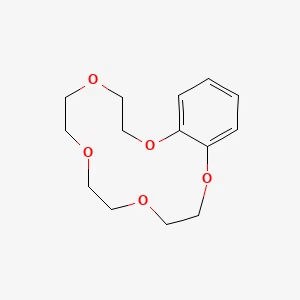
Benzo - 15 - crown - 5 Benzo - 15 - crown - 5丨CAS 14098 - 44 - 3 has a medium - sized cavity. It can bind to sodium (Na⁺) ions quite effectively. By forming a complex with sodium salts, it can improve their solubility in organic media.
Another factor that affects the solubility enhancement is the nature of the anion in the metal salt. Some anions are more easily solvated in organic solvents than others. For instance, large and weakly coordinating anions like perchlorate (ClO₄⁻) or tetrafluoroborate (BF₄⁻) can be more easily incorporated into the crown - ether - metal complex in organic solvents compared to small and strongly coordinating anions like chloride (Cl⁻) or hydroxide (OH⁻).
The temperature also plays a role. Generally, an increase in temperature can increase the solubility of the crown - ether - metal complex in organic solvents. This is because higher temperatures provide more energy for the dissolution process, allowing the complex to break free from intermolecular forces and disperse in the solvent.
The concentration of the crown ether is important too. If the concentration of the crown ether is too low, there may not be enough crown ether molecules to bind to all the metal ions. On the other hand, if the concentration is too high, it may lead to the formation of aggregates or other unwanted side - reactions.
Now, you might be wondering how this knowledge is useful in real - world applications. Well, there are many. In organic synthesis, the ability to dissolve metal salts in organic solvents can enable reactions that would otherwise be difficult or impossible. For example, some metal - catalyzed reactions require the metal catalyst to be in solution. By using crown ethers to increase the solubility of metal salts, we can make these reactions more efficient.
In analytical chemistry, crown ethers can be used to extract metal ions from aqueous solutions into organic solvents. This is useful for separating and detecting metal ions in complex mixtures.
As a crown ether supplier, I've seen firsthand how these compounds can make a big difference in various industries. Whether you're in research, pharmaceuticals, or materials science, crown ethers can offer unique solutions.
If you're interested in exploring the potential of crown ethers for your specific needs, I'd love to hear from you. Let's have a chat about how we can work together to find the right crown ether products for your projects. Whether you need Dibenzo - 18 - crown - 6, 12 - Crown - 4, Benzo - 15 - crown - 5, or other types of crown ethers, we've got you covered. Reach out to us and let's start a conversation about your requirements.
References
- Izatt, R. M., Pawlak, K., Bradshaw, J. S., & Bruening, R. L. (1991). The chemistry of complexation of metal ions by crown ethers. Chemical Reviews, 91(2), 1721 - 1787.
- Pedersen, C. J. (1967). Cyclic polyethers and their complexes with metal salts. Journal of the American Chemical Society, 89(26), 7017 - 7036.
- Gokel, G. W., & Murillo, O. (2009). Crown ethers and cryptands. Royal Society of Chemistry.


