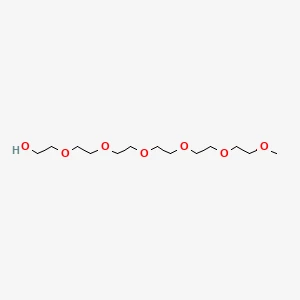
Hangzhou Leap Chem Co., Ltd. is one of the most professional manufacturers and suppliers of h2n-peg6-tbu丨cas 1286281-32-0 in China. Welcome to wholesale bulk high quality chemical products at competitive price from our factory. If you have any enquiry about custom service, please feel free to email us.
Specifications
| Appearance | Colorless to light yellow (Viscous liquid) |
| Purity (by HNMR) | 97% min |
| 1H NMR Spectrum | Consistent with structure |
| LCMS | Consistent with structure |
Applications
H2N-PEG6-tBu is widely used in pharmaceutical research, bioconjugation, and materials science as a functionalized polyethylene glycol (PEG) derivative. In drug development, it serves as a linker or spacer to attach therapeutic molecules, peptides, or antibodies, improving solubility, stability, and pharmacokinetic properties. The terminal amino group allows for covalent coupling to carboxyl, aldehyde, or activated ester groups, facilitating the synthesis of conjugates, prodrugs, and targeted delivery systems. The t-butyl protected PEG moiety is also applied in peptide synthesis and solid-phase chemistry to temporarily protect reactive sites and enhance solubility during multi-step reactions. Additionally, H2N-PEG6-tBu is used in materials research to modify surfaces, polymers, and nanoparticles, imparting hydrophilicity, steric stabilization, and biocompatibility.
Benefits
H2N-PEG6-tBu offers several advantages that make it valuable in chemical, pharmaceutical, and materials applications. Its PEG chain improves aqueous solubility and reduces aggregation or nonspecific binding of conjugated molecules, enhancing bioavailability and performance. The terminal amino group provides a reactive handle for selective and efficient conjugation to diverse functional groups. The t-butyl protection ensures stability during intermediate reaction steps and can be removed under mild conditions to expose the reactive amine when needed. Its modular structure and chemical stability facilitate reproducible synthesis, functionalization, and integration into complex molecular or material systems. These properties make it an effective tool for designing advanced drug conjugates, surface-modified materials, and peptide-based constructs.
Conclusion
H2N-PEG6-tBu is a versatile PEG derivative with applications in pharmaceutical conjugation, peptide synthesis, and materials modification. Its amino functionality, t-butyl protection, and hydrophilic PEG chain provide solubility, stability, and reactivity advantages. Overall, H2N-PEG6-tBu supports efficient bioconjugation, molecular design, and functional material development in both research and industrial contexts.