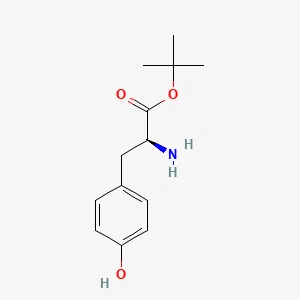

Hangzhou Leap Chem Co., Ltd. is one of the most professional manufacturers and suppliers of boc-l-3,4-dichlorophenyla丨cas 80741-39-5 in China. Welcome to wholesale bulk high quality chemical products at competitive price from our factory. If you have any enquiry about custom service, please feel free to email us.
Best Product Boc-L-3,4-Dichlorophenyla丨CAS 80741-39-5
Chemical Identifiers
| InChI | InChI=1S/C14H17Cl2NO4/c1-14(2,3)21-13(20)17-11(12(18)19)7-8-4-5-9(15)10(16)6-8/h4-6,11H,7H2,1-3H3,(H,17,20)(H,18,19)/t11-/m0/s1 |
| InChI Key | UGZIQCCPEDCGGN-NSHDSACASA-N |
| Smiles | CC(C)(C)OC(=O)N[C@@H](CC1=CC(=C(C=C1)Cl)Cl)C(=O)O |
| EC No. | 987-491-3 |
| MDL No. | MFCD00273436 |
| PubChem CID | 2734501 |
Applications
Pharmaceutical Research and Drug Discovery
Halogenated amino acids are valuable in medicinal chemistry because chlorine substituents can influence molecular lipophilicity, electronic properties, and interactions with biological targets. Boc-L-3,4-Dichlorophenylalanine may serve as an intermediate for preparing modified peptides and other research compounds used to investigate structure–activity relationships. Its defined stereochemistry and aromatic substitution pattern provide useful structural variables for molecular design and experimental evaluation.
Peptide Synthesis and Modified Peptide Development
Boc-protected amino acids are widely used in peptide synthesis to temporarily protect amino groups during selected stages of chain assembly. Boc-L-3,4-Dichlorophenylalanine can be used to introduce an L-configured amino acid with a dichlorinated aromatic side chain into suitable peptide sequences. Its application depends on the coupling method, deprotection strategy, and compatibility with the other building blocks in the target sequence.
Organic Synthesis and Chemical Research
Structure–Activity and Stereochemical Studies
Incorporating non-standard amino acids into peptides allows researchers to investigate how changes in side-chain structure affect conformation and molecular interactions. Boc-L-3,4-Dichlorophenylalanine may be used in suitable synthesis pathways for developing peptide analogues with a dichlorinated aromatic residue. Comparative studies with non-halogenated or differently substituted analogues can help evaluate the contribution of aromatic substitution to molecular properties, subject to experimental validation.