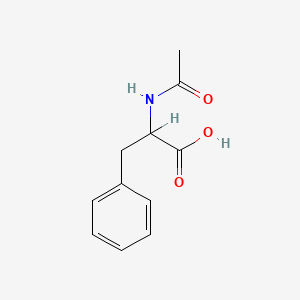
Hangzhou Leap Chem Co., Ltd. is one of the most professional manufacturers and suppliers of 4-bromophenylalanine丨cas 14091-15-7 in China. Welcome to wholesale bulk high quality chemical products at competitive price from our factory. If you have any enquiry about custom service, please feel free to email us.
Professional Supplier 4-Bromophenylalanine丨CAS 14091-15-7
Chemical Identifiers
| InChI | InChI=1S/C9H10BrNO2/c10-7-3-1-6(2-4-7)5-8(11)9(12)13/h1-4,8H,5,11H2,(H,12,13) |
| InChI Key | PEMUHKUIQHFMTH-UHFFFAOYSA-N |
| Smiles | C1=CC(=CC=C1CC(C(=O)O)N)Br |
| EC No. | 237-941-3 |
| MDL No. | MFCD00002599 |
| PubChem CID | 85681 |
Applications
Applications in Peptide Synthesis
As a non-standard amino acid building block, 4-Bromophenylalanine may be used in peptide research when a brominated aromatic side chain is required. Introducing this modified residue can help researchers investigate how aromatic substitution affects peptide structure, molecular interactions, and other properties. Depending on the synthesis strategy, the amino and carboxyl groups may require suitable protection or activation before incorporation into a peptide sequence.
Applications in Medicinal Chemistry
4-Bromophenylalanine can serve as an intermediate in the synthesis of amino-acid-derived compounds and structurally diverse research molecules. The bromine substituent offers opportunities for further aromatic functionalization, enabling researchers to prepare molecular analogues and explore structure–activity relationships. Its application depends on the target structure, the required stereochemistry, and the selected synthetic route.
Applications in Cross-Coupling Reactions
Applications in Chiral Building Block Development
4-Bromophenylalanine can support the preparation of specialized amino acid derivatives and other stereochemically defined molecules. Because the product's stereochemical identity is important in many pharmaceutical and peptide applications, users should confirm whether the required material is the L-isomer, D-isomer, or a racemic form before selecting a specification. This distinction helps ensure compatibility with the intended synthesis and research objectives.