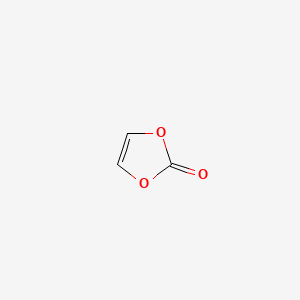
Hangzhou Leap Chem Co., Ltd. is one of the most professional manufacturers and suppliers of vinylene carbonate丨cas 872-36-6 in China. Welcome to wholesale bulk high quality chemical products at competitive price from our factory. If you have any enquiry about custom service, please feel free to email us.
Specifications of Vinylene carbonate丨CAS 872-36-6
|
Property |
Specification |
|
Appearance |
Colorless transparent liquid |
|
Assay (GC) |
99.95% min. |
|
Color (APHA) |
20 max. |
|
Water |
50 ppm max. |
|
BHT |
100 ppm max. |
|
Chloride ion |
10 ppm max. |
Transport Information of Vinylene carbonate丨CAS 872-36-6
|
Parameter |
Specification |
|
UN Number |
2810 |
|
Class |
6 |
|
Packing Group |
III |
|
H.S. Code |
2932999099 |
|
Stability & Reactivity |
The product is chemically stable under standard ambient conditions (room temperature). |
|
Storage |
Tightly closed. Keep away from heat and sources of ignition. Never allow product to get in contact with water during storage. Air and moisture sensitive. Handle and store under inert gas |
|
Condition to Avoid |
Water, air and high temperature |
|
Package |
Manufacturing Information of Vinylene carbonate丨CAS 872-36-6
|
Parameter |
Specification |
|
Capacity |
5,000MT/year |
|
Frequency |
|
|
Main Export Countries |
|
|
Capacity/Batch |
|
|
Experience |
Production since 2001 |
|
Stock |
Vinylene carbonate丨CAS 872-36-6 is an organic compound that is widely used in battery chemistry, particularly in lithium-ion batteries. It is a cyclic ester with a vinyl group and a carbonyl group that makes it a valuable electrolyte additive due to its chemical structure and properties. It can improve the performance and lifespan of batteries by stabilizing the electrolyte and preventing side reactions during charge-discharge cycles.
Key Applications of Vinylene carbonate丨CAS 872-36-6
1. Lithium-Ion Batteries (Battery Additive)
● Electrolyte Stabilizer: Vinylene carbonate is commonly used as an additive to the electrolyte in lithium-ion (Li-ion) batteries. It helps to form a stable solid electrolyte interface (SEI) layer on the anode during the initial charge cycle, which protects the anode from dissolution and degradation.
● Improved Cycle Life: By preventing the formation of unstable SEI layers, VC enhances the charge/discharge efficiency of batteries and prolongs their lifespan, especially under high charge/discharge rates or temperature variations.
● High-Performance Batteries: VC is particularly effective in high-capacity batteries and next-generation battery systems, including high-energy-density Li-ion and solid-state batteries.
2. Supercapacitors and Other Energy Storage Systems
● Used as an additive in supercapacitor electrolytes to improve the long-term stability of the supercapacitor's performance by enhancing ionic conductivity and preventing degradation of the electrode material.
3. Polymer Chemistry
● Polymerization Agent: Vinylene carbonate丨CAS 872-36-6 can be used in radical polymerization to synthesize specialty polymers. Its vinyl group makes it useful in copolymerization reactions, particularly for creating materials with specific functional properties.
● Adhesives: Employed in the production of adhesives or coatings where strong bonding, chemical resistance, or flexibility is required.
4. Organic Electronics
● Conductive Polymers: In the development of organic electronics, VC is used as an intermediate for making conductive polymer films and as a stabilizing agent for electronic materials, especially in organic solar cells and organic light-emitting diodes (OLEDs).
5. Chemical Intermediate
● Synthesis of Other Chemicals: VC can be used as a building block in the production of other specialty chemicals, including chemical intermediates for pharmaceuticals and fine chemicals.
Benefits of Vinylene carbonate丨CAS 872-36-6
1. Enhanced Battery Performance
● Solid Electrolyte Interface (SEI) Formation: VC contributes to the formation of a thin, stable SEI layer on the anode, which reduces side reactions, improves charge retention, and enhances battery safety.
● Extended Battery Lifespan: It reduces the degradation of electrodes during repeated charge/discharge cycles, increasing the cycle life of lithium-ion batteries.
2. Improved Stability Under Extreme Conditions
● High-Temperature Performance: It helps to maintain battery performance and stability at elevated temperatures, which is critical for batteries used in electric vehicles (EVs), grid storage, and consumer electronics.
● Reduced Capacity Fade: With the addition of VC to the electrolyte, batteries experience less capacity fade over time, allowing for longer-lasting energy storage.
3. Environmentally Friendly
● Compared to other electrolytes or additives, VC is considered to be more environmentally friendly because it breaks down into non-toxic byproducts after use, making it a better alternative for sustainable energy storage solutions.
4. Cost-Effective and High Performance
● VC is relatively cost-effective compared to other electrolyte additives, while still offering high performance, making it an attractive choice for manufacturers looking to improve battery efficiency without significantly increasing costs.
5. Versatile in Chemical Synthesis
● Beyond its applications in batteries, VC serves as a reactive intermediate for the synthesis of various polymers and organic materials with specialized functions, thus adding versatility to its industrial applications.
Conclusion
Vinylene carbonate丨CAS 872-36-6is a critical additive in modern battery technology, especially for lithium-ion batteries, where it significantly enhances performance, stability, and longevity. By contributing to the formation of a stable SEI layer, VC helps reduce side reactions, extends battery life, and improves energy efficiency. Its applications also extend beyond energy storage to fields like polymer chemistry, organic electronics, and chemical synthesis.