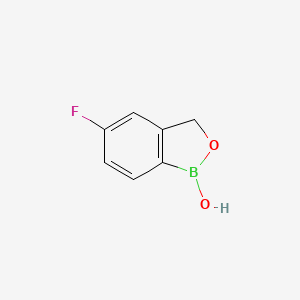
Hangzhou Leap Chem Co., Ltd. is one of the most professional manufacturers and suppliers of tavaborole丨cas 174671-46-6 in China. Welcome to wholesale bulk high quality chemical products at competitive price from our factory. If you have any enquiry about custom service, please feel free to email us.
Best Tavaborole丨CAS 174671-46-6
Chemical Identifiers
| InChI | InChI=1S/C7H6BFO2/c9-6-1-2-7-5(3-6)4-11-8(7)10/h1-3,10H,4H2 |
| InChI Key |
LFQDNHWZDQTITF-UHFFFAOYSA-N |
| Smiles | B1(C2=C(CO1)C=C(C=C2)F)O |
| EC No. | 690-763-1 |
| MDL No. | MFCD10699483 |
| PubChem CID | 11499245 |
Applications
Applications in Antifungal Treatment
Tavaborole is used as an active ingredient in topical pharmaceutical formulations for the treatment of onychomycosis, a fungal infection affecting the nails. In the United States, Tavaborole 5% topical solution is approved for treating toenail onychomycosis caused by Trichophyton rubrum and Trichophyton mentagrophytes. Its antifungal activity results from interference with fungal protein synthesis, providing a mechanism distinct from those of conventional azole and allylamine antifungal agents. Tavaborole is therefore relevant to pharmaceutical products designed for localized treatment of susceptible fungal nail infections.
Applications in Topical Pharmaceutical Formulation Development
Tavaborole is an important compound for research involving topical drug delivery and antifungal formulation development. Researchers may investigate its solubility, stability, compatibility with pharmaceutical excipients, and behavior in different solvent systems. Its molecular characteristics make it particularly relevant to studies of drug penetration through the nail plate, an important consideration in developing effective topical treatments for onychomycosis. Formulation development may involve evaluating drug release, nail permeation, product stability, and other performance characteristics under suitable experimental conditions.
Applications in Antifungal Mechanism Research
Tavaborole is widely recognized for its distinctive antifungal mechanism involving the inhibition of fungal leucyl-transfer RNA synthetase (LeuRS). The compound interferes with the enzyme's editing function, disrupting normal transfer RNA processing and inhibiting fungal protein synthesis. This mechanism makes Tavaborole useful in biochemical research involving aminoacyl-tRNA synthetases, enzyme inhibition, and boron-containing antifungal compounds. Researchers may use it as a reference molecule when investigating alternative approaches to antifungal drug discovery.
Applications in Medicinal Chemistry
In medicinal chemistry, Tavaborole serves as an example of the pharmaceutical potential of benzoxaborole compounds. Its cyclic boron-containing framework demonstrates how boron chemistry can contribute to specific biological interactions. Researchers may investigate Tavaborole and structurally related compounds to explore structure–activity relationships, enzyme-binding characteristics, and the influence of molecular substitution on antifungal activity. Such studies can support broader research into boron-based pharmaceutical compounds and the development of new chemical entities.