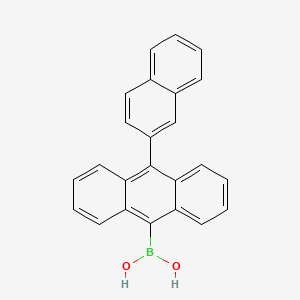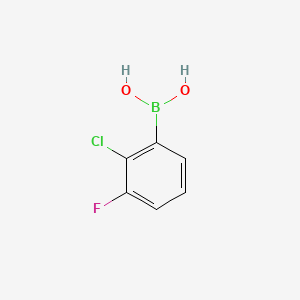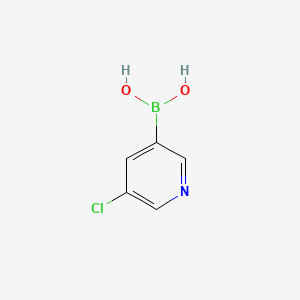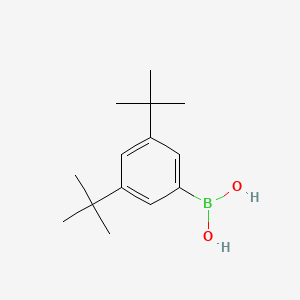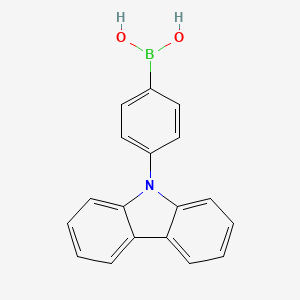
Hangzhou Leap Chem Co., Ltd. is one of the most professional manufacturers and suppliers of 4-(9h-carbazol-9-yl)phenylboronic acid丨cas 419536-33-7 in China. Welcome to wholesale bulk high quality chemical products at competitive price from our factory. If you have any enquiry about custom service, please feel free to email us.
High Quality 4-(9H-Carbazol-9-yl)phenylboronic Acid丨CAS 419536-33-7
Chemical Identifiers
| InChI | 1S/C18H14BNO2/c21-19(22)13-9-11-14(12-10-13)20-17-7-3-1-5-15(17)16-6-2-4-8-18(16)20/h1-12,21-22H |
| InChI Key | JGAVTCVHDMOQTJ-UHFFFAOYSA-N |
| Smiles | OB(C1=CC=C(N2C3=C(C4=C2C=CC=C4)C=CC=C3)C=C1)O |
| EC No. | 808-009-9 |
| MDL No. | MFCD13176534 |
| PubChem CID | 23120827 |
Applications
Applications in Suzuki–Miyaura Cross-Coupling Reactions
The boronic acid group of 4-(9H-Carbazol-9-yl)phenylboronic acid enables its use in Suzuki–Miyaura cross-coupling reactions. Under appropriately optimized palladium-catalyzed conditions, the compound can react with compatible aryl or heteroaryl halides and pseudohalides to form new carbon–carbon bonds. This transformation provides a practical route for incorporating a carbazole-substituted phenyl fragment into more complex molecular frameworks. The para-position of the boronic acid group allows the construction of extended aromatic structures containing a carbazole unit. Such reactions are useful for preparing functionalized biaryl compounds, advanced OLED intermediates, and specialty organic electronic materials.
Applications in OLED Materials Research
4-(9H-Carbazol-9-yl)phenylboronic acid is particularly relevant to the synthesis of organic compounds investigated in organic light-emitting diode (OLED) technology. Carbazole-containing structures are frequently explored in the design of host materials, hole-transport materials, and other functional organic electronic components. The carbazole framework provides an electron-rich aromatic unit, while the para-substituted phenyl group offers a defined connection point for extending the molecular structure. Through suitable cross-coupling reactions, this compound can be incorporated into larger aromatic architectures containing additional electron-donating or electron-accepting fragments. Researchers may evaluate the resulting derivatives for charge-transport characteristics, energy-level alignment, thermal behavior, and OLED device performance.
Applications in OLED Host Material Development
Carbazole-based molecular structures are important in OLED host material research because their electronic and excited-state characteristics can be adjusted through molecular design. 4-(9H-Carbazol-9-yl)phenylboronic acid provides a useful intermediate for preparing host material candidates containing carbazole and other aromatic or heteroaromatic units. The para-substituted phenyl framework allows researchers to construct molecular architectures with different conjugation lengths and electronic characteristics. By selecting appropriate coupling partners, derivatives can be designed for investigating excited-state energies, charge balance, host–dopant compatibility, and thermal stability. Their suitability for fluorescent or phosphorescent OLED applications depends on the experimentally determined properties of the final compounds.
Applications in Hole-Transport Materials Research
The carbazole framework is widely investigated in organic hole-transport materials because of its electron-donating characteristics and ability to participate in charge-transport processes within suitable molecular systems. 4-(9H-Carbazol-9-yl)phenylboronic acid can serve as a precursor for preparing carbazole-functionalized aromatic compounds intended for hole-transport studies. Through coupling with selected aromatic or heteroaromatic partners, researchers can modify molecular size, electronic structure, and intermolecular interactions. The resulting materials may be evaluated for hole mobility, energy-level alignment, film-forming characteristics, and thermal stability. Actual performance depends on molecular architecture, material purity, processing conditions, and device design.