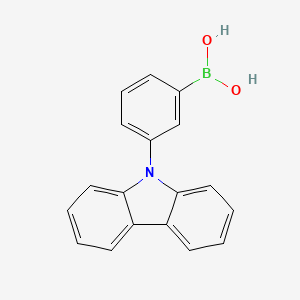
Hangzhou Leap Chem Co., Ltd. is one of the most professional manufacturers and suppliers of 3-(9h-carbazol-9-yl)phenylboronic acid丨cas 864377-33-3 in China. Welcome to wholesale bulk high quality chemical products at competitive price from our factory. If you have any enquiry about custom service, please feel free to email us.
Top Selected 3-(9H-Carbazol-9-yl)phenylboronic Acid丨CAS 864377-33-3
Chemical Identifiers
| InChI | InChI=1S/C18H14BNO2/c21-19(22)13-6-5-7-14(12-13)20-17-10-3-1-8-15(17)16-9-2-4-11-18(16)20/h1-12,21-22H |
| InChI Key | IDQUIFLAFFZYEX-UHFFFAOYSA-N |
| Smiles |
B(C1=CC(=CC=C1)N2C3=CC=CC=C3C4=CC=CC=C42)(O)O |
| EC No. | 808-027-7 |
| MDL No. | MFCD18072506 |
| PubChem CID | 56965778 |
Applications
Applications in Suzuki–Miyaura Cross-Coupling Reactions
The boronic acid group of 3-(9H-Carbazol-9-yl)phenylboronic acid enables its use in Suzuki–Miyaura cross-coupling reactions. Under appropriate palladium-catalyzed conditions, the compound can react with compatible aryl or heteroaryl halides and pseudohalides to form new carbon–carbon bonds. This reaction provides a convenient route for incorporating a carbazole-substituted phenyl fragment into larger molecular frameworks. It is particularly useful for preparing functionalized biaryl compounds, conjugated aromatic systems, and advanced intermediates for electronic materials research. Reaction conditions may require optimization depending on the coupling partner, catalyst system, solvent, and desired product structure.
Applications in OLED Materials Research
3-(9H-Carbazol-9-yl)phenylboronic acid is particularly relevant to the synthesis of organic compounds investigated in organic light-emitting diode (OLED) technology. Carbazole-containing structures are frequently used in the molecular design of OLED host materials, hole-transport materials, and other functional organic electronic components. The carbazole unit provides an electron-rich aromatic framework, while the meta-substituted phenyl linkage offers a structural arrangement that can influence electronic communication between molecular fragments. Through suitable cross-coupling reactions, this compound can be incorporated into more complex aromatic architectures for evaluating charge transport, excited-state energy levels, thermal properties, and device performance. Its suitability for specific OLED applications depends on the complete molecular structure and experimentally measured characteristics of the resulting material.
Applications in Organic Semiconductor Research
3-(9H-Carbazol-9-yl)phenylboronic acid may support the development of organic semiconductor compounds containing nitrogen-based aromatic units. The carbazole structure offers a rigid molecular framework with electronic characteristics that can be modified through additional aromatic substitution. Researchers may use this compound to synthesize candidate materials for investigating charge transport, energy-level alignment, molecular packing, and solid-state organization. The ability to connect the carbazole-containing fragment with different aromatic partners provides flexibility in designing molecules for exploratory organic electronics research.
Applications in Hole-Transport Materials Research
The carbazole framework is widely investigated in organic hole-transport materials because of its electron-donating characteristics and ability to participate in charge-transport processes within suitable molecular systems. 3-(9H-Carbazol-9-yl)phenylboronic acid can serve as a precursor for preparing carbazole-functionalized aromatic compounds designed for hole-transport studies. Through coupling with selected aromatic or heteroaromatic partners, researchers can modify molecular size, electronic structure, and intermolecular interactions. The resulting derivatives may be evaluated for charge mobility, energy-level alignment, film-forming behavior, and thermal stability. Actual performance depends on molecular design, material purity, processing conditions, and device architecture.