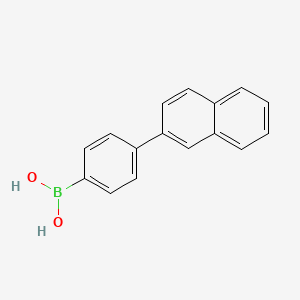
Hangzhou Leap Chem Co., Ltd. is one of the most professional manufacturers and suppliers of 2-(trifluoromethyl)benzeneboronic acid丨cas 1423-27-4 in China. Welcome to wholesale bulk high quality chemical products at competitive price from our factory. If you have any enquiry about custom service, please feel free to email us.
Major Supplier 2-(Trifluoromethyl)benzeneboronic acid丨CAS 1423-27-4
Chemical Identifiers
| InChI | 1S/C7H6BF3O2/c9-7(10,11)5-3-1-2-4-6(5)8(12)13/h1-4,12-13H |
| InChI Key | JNSBEPKGFVENFS-UHFFFAOYSA-N |
| Smiles | C1=CC=CC(=C1C(F)(F)F)B(O)O |
| EC No. | 640-203-7 |
| MDL No. | MFCD00236059 |
| PubChem CID | 2734387 |
Applications
Applications in Pharmaceutical Intermediate Synthesis
2-(Trifluoromethyl)benzeneboronic acid is valuable in medicinal chemistry for introducing a 2-trifluoromethylphenyl group into complex molecular structures. The trifluoromethyl group is frequently incorporated into pharmaceutical research compounds because it can influence lipophilicity, metabolic stability, electron distribution, and molecular interactions. Through suitable cross-coupling reactions with aryl or heteroaryl electrophiles, this compound enables the preparation of fluorinated biaryl intermediates for lead optimization, structure–activity relationship studies, and pharmaceutical compound development. Its ortho-substitution pattern also provides a useful structural feature for investigating steric effects in molecular design.
Applications in Suzuki–Miyaura Cross-Coupling Reactions
A principal application of 2-(Trifluoromethyl)benzeneboronic acid is palladium-catalyzed Suzuki–Miyaura cross-coupling. Its boronic acid functionality can react with compatible aryl and heteroaryl halides or pseudohalides to form carbon–carbon bonds, providing access to trifluoromethyl-substituted biaryl structures. The CF₃ group generally remains part of the product under appropriately selected coupling conditions, preserving its electronic and physicochemical influence. Because the boronic acid group is positioned adjacent to the bulky trifluoromethyl substituent, steric effects may need to be considered when selecting catalysts, ligands, bases, and reaction conditions.
Applications in Agrochemical and Fine Chemical Research
Trifluoromethyl-containing aromatic structures are widely explored in agrochemical discovery and specialty chemical development. The CF₃ group can modify molecular polarity, lipophilicity, and chemical stability, making it an important structural feature in the design of research compounds. 2-(Trifluoromethyl)benzeneboronic acid provides a synthetic route to incorporating this fluorinated aromatic fragment into larger molecular frameworks through suitable coupling reactions. It can support the preparation of fluorinated intermediates for evaluating molecular properties and potential applications in crop protection and fine chemical research.
Applications in Functional Materials Research
The combination of an aromatic ring and a strongly electron-withdrawing trifluoromethyl group makes this compound relevant to the preparation of specialized organic materials. Through cross-coupling reactions, it can be incorporated into extended aromatic structures investigated for their electronic, optical, and thermal properties. Fluorinated substituents may influence molecular polarity, intermolecular interactions, and material behavior, making this building block useful in the development of functional organic molecules and advanced materials.