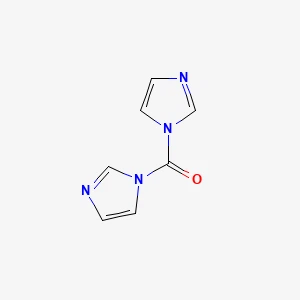
Hangzhou Leap Chem Co., Ltd. is one of the most professional manufacturers and suppliers of 9-borabicyclo3.3.1nonane丨cas 280-64-8 in China. Welcome to wholesale bulk high quality chemical products at competitive price from our factory. If you have any enquiry about custom service, please feel free to email us.
Specifications
|
Appearance |
Colorless liquid |
|
Conc. (hydrogen evolution) |
0.50M to 0.60M |
Transport Information
|
Parameter |
Specification |
|
UN Number |
3399 |
|
Class |
|
|
Packing Group |
|
|
H.S. Code |
2934999099 |
|
Stability & Reactivity |
The product is chemically stable under standard ambient conditions. |
|
Storage |
Tightly closed. Keep away from heat and sources of ignition. Never allow product to get in contact with water during storage. Handle and store under inert gas. Heat- and air-sensitive. Test for peroxide formation periodically and before distillation. |
|
Condition to Avoid |
|
|
Package |
Overview
9-Borabicyclo3.3.1nonane丨CAS 280-64-8 is a stable, bicyclic organoborane compound widely used in organic synthesis. It is renowned for its high regioselectivity in hydroboration reactions and is a key reagent in forming C–B bonds for further functionalization. It's typically used as a solution in tetrahydrofuran (THF) due to its solid form being less convenient to handle.
Applications
1. Hydroboration Reactions
9-Borabicyclo3.3.1nonane丨CAS 280-64-8 is a highly selective hydroborating agent.
Adds boron to the less hindered carbon in alkenes and alkynes (anti-Markovnikov addition).
Ideal for making primary organoboranes, which can be easily oxidized to alcohols or used in further cross-coupling reactions.
2. Suzuki–Miyaura Coupling
After hydroboration, the resulting alkylborane can participate in Suzuki cross-coupling to form new C–C bonds.
This is essential in the synthesis of complex molecules, pharmaceuticals, and natural products.
3. Stereoselective Synthesis
9-BBN shows excellent stereoselectivity and regioselectivity, making it highly useful in the synthesis of chiral compounds.
It is often used in asymmetric synthesis when paired with chiral ligands or catalysts.
4. Synthesis of Alcohols
Through oxidative workup (e.g., with H2O2/NaOH), 9-BBN-treated alkenes yield primary alcohols in high yield and selectivity.
Preferred over BH3 for sensitive or complex substrates.
5. Organic Electronic Materials
Organoboranes like 9-BBN are used in the development of electronic materials, OLEDs, and semiconducting polymers where boron atoms enhance electron transport or light emission properties.
6. Pharmaceutical and Agrochemical Synthesis
Enables synthesis of intermediates for active pharmaceutical ingredients (APIs).
Common in the preparation of herbicides, fungicides, and other agrochemicals via boron-mediated transformations.
Benefits
1. High Regioselectivity
9-BBN's bulky structure ensures excellent regioselectivity during hydroboration, favoring addition to terminal alkenes or less hindered sites.
2. Mild Reaction Conditions
Works under ambient temperature and pressure, making it suitable for sensitive compounds and lab-scale or industrial processes.
3. Safer Alternative to BH₃
More thermally stable and less volatile than borane (BH₃) complexes.
Offers greater control and safety during handling and reactions.
4. Versatile Intermediate
The organoborane intermediates formed from 9-BBN are useful synthetic handles for further transformation via oxidation, coupling, or substitution reactions.
5. Scalability
Its commercial availability and scalability make it a preferred reagent in industrial organic synthesis.
Summary
9-Borabicyclo3.3.1nonane丨CAS 280-64-8 is a powerful and selective hydroboration reagent that plays a vital role in modern organic synthesis. Its high regioselectivity, compatibility with mild conditions, and utility in cross-coupling reactions make it indispensable for making complex molecules, especially in pharmaceutical, agrochemical, and materials chemistry contexts.