

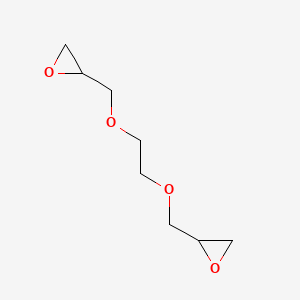
Hangzhou Leap Chem Co., Ltd. is one of the most professional manufacturers and suppliers of ethylene glycol diglycidyl ether丨cas 2224-15-9 in China. Welcome to wholesale bulk high quality chemical products at competitive price from our factory. If you have any enquiry about custom service, please feel free to email us.
Specifications of Ethylene glycol diglycidyl ether丨2224-15-9
|
Property |
Value |
|
Appearance |
Clear Liquid |
|
Color (APHA) |
30 max |
|
Viscosity |
15 mPa.s to 30 mPa.s |
|
Epoxy value |
0.74 eq/100g to 0.79 eq/100g |
|
Easily saponifiable chlorine |
0.5% max |
|
Inorganic chlorine |
20 ppm max |
|
Water |
0.1% max |
Transport Information of Ethylene glycol diglycidyl ether丨2224-15-9
|
Parameter |
Specification |
|
UN Number |
|
|
Class |
|
|
Packing Group |
|
|
H.S. Code |
2909499090999 |
|
Stability & Reactivity |
Stable |
|
Storage |
Tightly closed. Store in a closed, dry, ventilated place |
|
Condition to Avoid |
excessive heat and light. |
|
Package |
Manufacturing Information of Ethylene glycol diglycidyl ether丨2224-15-9
|
Parameter |
Specification |
|
Capacity |
10MT/month |
|
Frequency |
|
|
Main Export Countries |
|
|
Capacity/Batch |
|
|
Experience |
|
|
Facilities |
Introduction
Ethylene glycol diglycidyl ether丨2224-15-9 is an organic compound that is primarily used as a reactive diluent in epoxy resins, curing agents, and in other industrial applications. It is part of the family of glycidyl ethers, which are characterized by the presence of epoxide groups (three-membered oxygen-containing rings) attached to the molecule. Its versatile chemical properties make it useful in polymer chemistry, coatings, and adhesives.
Applications of Ethylene glycol diglycidyl ether丨2224-15-9
Epoxy Resin Curing Agent:
One of the most common uses of ethylene glycol diglycidyl ether is as a reactive diluent in epoxy resin systems. Epoxy resins are widely used in the manufacture of adhesives, coatings, and composites. Ethylene glycol diglycidyl ether reduces the viscosity of the resin while maintaining or enhancing the properties of the final cured product.
The compound has two epoxide groups, allowing it to crosslink with other components in the resin system, leading to a cured polymer that exhibits improved mechanical properties and chemical resistance.
It is commonly used in epoxy coatings for automotive, industrial, and marine applications, where it contributes to the durability, adhesion, and corrosion resistance of the coatings.
Polymer Chemistry and Resin Modification:
Ethylene glycol diglycidyl ether丨2224-15-9 is also used to modify or functionalize other polymers by introducing epoxy groups that can react with various curing agents. This property makes it useful for polymer modification in applications like adhesives and composites.
It can be reacted with amines, acid anhydrides, and other reactive compounds to form epoxy-based polymers, improving the flexibility, adhesion, and strength of the final materials.
Formulation of Adhesives and Sealants:
The compound is used in the formulation of adhesives and sealants because of its ability to form strong, flexible bonds with a wide variety of substrates, including metals, plastics, and ceramics. Its epoxide functionality provides excellent bonding properties and ensures good performance in high-stress environments.
Structural adhesives used in aerospace, automotive, and construction industries often incorporate ethylene glycol diglycidyl ether as a key component for improved curing speed and bonding strength.
Surface Coatings and Paints:
Ethylene glycol diglycidyl ether丨2224-15-9 is used in the production of coatings and paints, particularly for high-performance applications where chemical resistance, corrosion protection, and abrasion resistance are critical.
It is commonly found in epoxy-based coatings that are used for protecting metal surfaces, concrete, and marine vessels. The addition of the compound helps enhance the film formation and adhesion properties of the coating.
Composites Manufacturing:
In composite materials, Ethylene glycol diglycidyl ether丨2224-15-9 serves as a resin component that helps bind reinforcing fibers such as glass or carbon. When used in combination with other resin systems, it provides a stiff, strong, and lightweight composite material.
It is used in the manufacture of fiber-reinforced composites for industries such as aerospace, automotive, and construction, where high strength-to-weight ratios are essential.
Crosslinking Agent for Polyurethanes:
Ethylene glycol diglycidyl ether can be used as a crosslinking agent in the synthesis of polyurethane resins. The epoxy groups on the molecule react with amines or isocyanates to form crosslinked networks that enhance the chemical resistance, mechanical strength, and thermal stability of polyurethane-based products.
Synthesis of Special Polymers:
It is also used in the synthesis of specialty polymers, including polymer blends and copolymers, where it imparts desirable properties like adhesion to substrates, flexibility, and durability in extreme conditions.
Conclusion
Ethylene glycol diglycidyl ether丨2224-15-9 is a valuable compound in the industrial sector, especially in the production of epoxy resins, adhesives, coatings, and composites. Its ability to act as a reactive diluent and curing agent enhances the performance of polymer systems by improving their mechanical properties, adhesion, and chemical resistance. Despite its versatility, it is important to handle the compound with care due to its toxicity and potential health hazards. Proper safety protocols, including the use of protective equipment and working in well-ventilated areas, should always be followed to minimize risks to health and the environment.


