

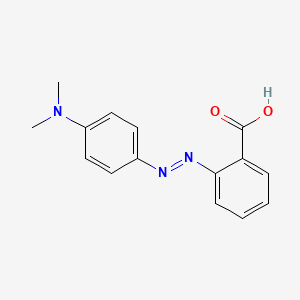
Hangzhou Leap Chem Co., Ltd. is one of the most professional manufacturers and suppliers of methyl red丨cas 493-52-7 in China. Welcome to wholesale bulk high quality chemical products at competitive price from our factory. If you have any enquiry about custom service, please feel free to email us.
Specifications of Methyl Red丨CAS 493-52-7
|
Property |
Specification |
|
Appearance |
Dark red and black crystalline powder |
|
pH Color Change Interval |
4.5 (red) to 6.2 (yellow) |
|
Ethanol Soluble Test |
Qualified |
|
Burning Residue |
2% max |
|
Loss on Drying |
5% max |
Transport Information of Methyl Red丨CAS 493-52-7
|
Parameter |
Specification |
|
UN Number |
1170 |
|
Class |
|
|
Packing Group |
|
|
H.S. Code |
|
|
Stability & Reactivity |
Stable. Incompatible with strong oxidants. |
|
Storage |
Tightly closed. Store in a closed, dry, ventilated place |
|
Condition to Avoid |
|
|
Package |
Methyl Red丨CAS 493-52-7 is a well-known azo dye and pH indicator used primarily in analytical chemistry and microbiological testing. It changes color depending on the pH of the solution, making it a vital tool in acid-base titrations and bacterial fermentation tests.
Key Applications of Methyl Red丨CAS 493-52-7
1. pH Indicator in Acid-Base Titrations
● Methyl Red丨CAS 493-52-7 is commonly used in titrimetric analysis as an indicator to detect the endpoint of titrations involving strong acids and weak bases.
● It exhibits a clear and distinct color transition from red (acidic) to yellow (neutral/alkaline), which helps chemists visually determine when the reaction is complete.
2. Microbiology: Methyl Red Test (MR Test)
● A critical component of the IMViC test series (Indole, Methyl Red, Voges-Proskauer, Citrate) used to differentiate Enterobacteriaceae family bacteria.
● In the MR test, methyl red detects stable acid production from glucose fermentation by certain bacteria (e.g., Escherichia coli).
o Positive result: Medium remains red (acidic, pH < 4.4)
o Negative result: Medium turns yellow (pH > 6.2)
3. Educational Use in Laboratories
● Widely used in academic laboratories for demonstrating acid-base reactions, indicator properties, and spectroscopic behavior of azo compounds.
● It helps students visualize chemical changes and learn about titration and pH measurement techniques.
4. Colorimetric Assays
● Used in research settings for colorimetric detection of specific chemical species or reaction conditions.
● Can function in enzyme kinetics or reaction monitoring when pH change is a variable of interest.
5. Dye and Pigment Research
● As an azo compound, Methyl Red is also studied in dye chemistry for its structural properties, light absorption, and degradation behavior.
● Employed in research exploring azo bond cleavage and biodegradation by microorganisms.
Benefits of Methyl Red丨CAS 493-52-7
1. Sharp Color Transition
● Provides a vivid and reliable color shift (red to yellow) that makes endpoint detection clear and user-friendly, especially in titrations and microbial assays.
2. Stable and Reproducible
● Offers good shelf life and consistent performance under standard laboratory conditions.
● Resists degradation under normal light and temperature, ensuring accurate results in repeat experiments.
3. Widely Accepted and Standardized
● Incorporated into many standard microbiological and chemical test protocols, ensuring comparability of results across laboratories and studies.
4. Cost-effective and Easy to Use
● Inexpensive and easy to prepare as a solution in ethanol or water.
● Its simplicity and reliability make it ideal for both research and routine quality control applications.
Conclusion
Methyl Red丨CAS 493-52-7 is a trusted and versatile chemical indicator, valued in analytical chemistry, microbiology, and chemical education. Its reliable pH-dependent color change, ease of use, and low cost make it an essential tool in laboratories around the world. Whether used in acid-base titrations or the differentiation of bacterial species, Methyl Red remains a cornerstone reagent for qualitative chemical analysis.


