Hey there, fellow chemistry enthusiasts! Today, I'm stoked to chat about the super cool role of crown ethers in supramolecular chemistry. And hey, I'm not just some random blogger; I'm part of a crown ether supplier team, so I've got some insider knowledge to share.
Let's start with the basics. Supramolecular chemistry is all about the non - covalent interactions between molecules. It's like the social network of the chemical world, where molecules interact, form complexes, and create new structures without actually forming traditional chemical bonds. And crown ethers are like the popular kids in this social network.
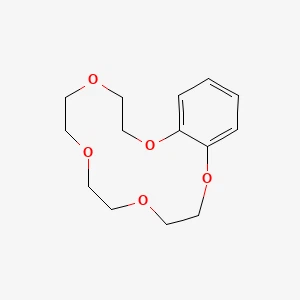
Crown ethers are cyclic polyethers with a cavity in the middle. They've got this unique structure that looks a bit like a crown, hence the name. The size of the cavity can vary depending on the number of ether oxygen atoms and the length of the carbon chains connecting them. This variation in cavity size is what makes crown ethers so special.
One of the main roles of crown ethers in supramolecular chemistry is their ability to act as host molecules. They can selectively bind to guest molecules, usually metal cations, in their cavity through ion - dipole interactions. The oxygen atoms in the crown ether have lone pairs of electrons that can interact with the positively charged metal ions.
For example, dibenzo - 18 - crown - 6 Dibenzo - 18 - crown - 6丨CAS 14187 - 32 - 7 has a relatively large cavity. It's really good at binding to potassium ions (K⁺). The size of the cavity in dibenzo - 18 - crown - 6 is just right to accommodate a potassium ion, and the oxygen atoms can form a nice, stable interaction with it. This selective binding is super important in many chemical processes.
In chemical synthesis, crown ethers can be used as phase - transfer catalysts. You know how sometimes you've got a reaction where the reactants are in different phases, like one in an organic phase and the other in an aqueous phase? Well, crown ethers can help transfer ions from one phase to another. They can pick up a metal ion from the aqueous phase, carry it into the organic phase, and then release it there. This allows the reaction to take place more efficiently.
Let's say you're doing a reaction that involves a halide ion in an organic solvent. But the halide salt is usually soluble in water. By using a crown ether, you can transfer the halide ion from the aqueous phase to the organic phase. For instance, benzo - 15 - crown - 5 Benzo - 15 - crown - 5丨CAS 14098 - 44 - 3 can bind to sodium ions (Na⁺) and help transfer them along with their associated anions between phases. This can significantly speed up reactions that would otherwise be very slow or not happen at all.
Another interesting application of crown ethers in supramolecular chemistry is in the design of molecular sensors. Since crown ethers can selectively bind to certain metal ions, we can use this property to detect the presence of those ions in a solution. We can attach a fluorescent or color - changing group to the crown ether. When the crown ether binds to the target metal ion, the attached group will change its fluorescence or color, giving us a signal that the ion is present.
12 - Crown - 4 12 - Crown - 4丨CAS 294 - 93 - 9 has a relatively small cavity and is selective for lithium ions (Li⁺). We could potentially use a modified 12 - crown - 4 to detect lithium ions in a sample. This is really useful in environmental monitoring, where we need to detect trace amounts of metal ions in water or soil.
In the field of materials science, crown ethers can be used to create supramolecular polymers. Supramolecular polymers are polymers held together by non - covalent interactions. Crown ethers can act as building blocks in these polymers. They can form complexes with metal ions, and these complexes can then interact with other molecules to form long - chain structures. This gives us a new way to design materials with unique properties.
The self - assembly of crown ethers and their complexes is also a fascinating area of study. Crown ethers can self - assemble into different structures depending on the conditions and the guest molecules they interact with. They can form micelles, vesicles, or other ordered structures. These self - assembled structures can have potential applications in drug delivery, where we can use them to encapsulate drugs and release them in a controlled manner.

Now, if you're in the market for high - quality crown ethers for your research or industrial applications, we've got you covered. We're a crown ether supplier with a wide range of products, including the ones I've mentioned above. Our crown ethers are synthesized with the highest standards of quality, ensuring that you get reliable and consistent results in your experiments.
Whether you're working on a small - scale research project or a large - scale industrial process, we can provide you with the right crown ether for your needs. If you're interested in learning more about our products or have any questions, feel free to reach out to us. We'd love to have a chat and discuss how we can help you with your crown ether requirements.
In conclusion, crown ethers play a crucial role in supramolecular chemistry. Their ability to selectively bind to guest molecules, act as phase - transfer catalysts, be used in sensors and materials science, and self - assemble into interesting structures makes them invaluable in the world of chemistry. So, if you're looking to explore the exciting world of supramolecular chemistry, don't forget about these amazing crown ethers.
References
- Lehn, J.-M. (1988). Supramolecular Chemistry - Scope and Perspectives Molecules, Supermolecules, and Molecular Devices. Angewandte Chemie International Edition in English, 27(1), 89 - 112.
- Pedersen, C. J. (1967). Cyclic Polyethers and Their Complexes with Metal Salts. Journal of the American Chemical Society, Vol. 89, No. 26, pp. 7017 - 7036.
- Gokel, G. W. (2004). Crown Ethers and Cryptands. Royal Society of Chemistry.